Understanding Complexity at the Heart of Human Systems
Understanding Complexity at the Heart of Human Systems.
The previous article introduced the Golden Triangle: People, Process and Technology—three dimensions that together shape every knowledge-intensive human system.
Over the years, however, I came to a conclusion that changed the way I understand leadership: although these three dimensions are deeply connected, they do not represent the same kind of complexity.
Processes can be designed and technology can be engineered, but people need to be understood. They learn from experience, respond differently to the same circumstances, build relationships and continuously adapt to what happens around them.
And when people collaborate over time, this learning and adaptation no longer happen only at an individual level. Their interactions, experiences and relationships gradually form a human system: a living system that continuously learns, adapts and evolves.
The complexity we usually ignore
When we try to understand a team, we usually begin with what is easiest to measure: velocity, lead time, cycle time, KPIs, incidents or defects. These indicators are useful, but they mostly describe the visible behaviour of the system.
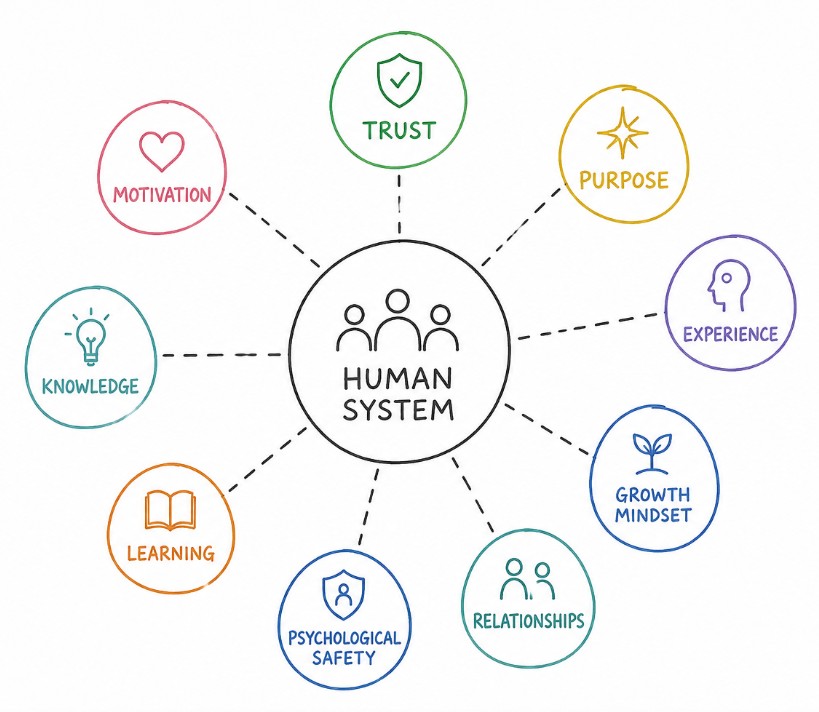
Beneath them lies another reality that is much harder to observe:
- Trust
- Motivation
- Shared Knowledge
- Psychological Safety
- Relationships
- Learning Capacity
- Purpose
- Confidence
- Experience
These variables rarely appear on a dashboard, yet they strongly influence how people collaborate, share knowledge, make decisions and adapt to change. Ultimately, they shape how the system evolves and how much value it can create over time.
Among them, motivation plays a particularly important role—not simply as an emotional state, but as the energy that keeps a human system moving through time. A motivated system learns faster, shares knowledge more naturally and responds to uncertainty with greater resilience.
When these variables deteriorate, organisations often respond with new methodologies, tools or processes. Sometimes they help; other times they simply address the symptoms rather than the underlying cause.
Understanding what cannot easily be measured is often more important than optimising what can.
Nothing stays the same
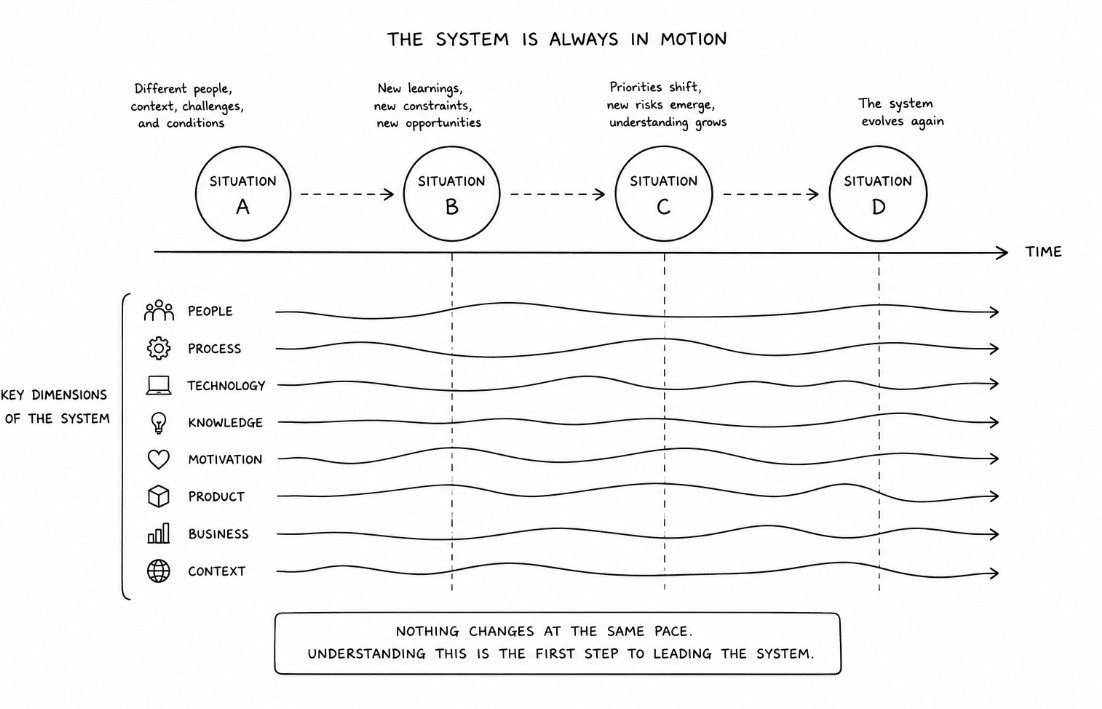
Perhaps the biggest mistake we make as leaders is assuming that a team remains in the same state over time.
Reality is very different. People, products, technology, business priorities, knowledge, relationships and even motivation all evolve continuously. More importantly, the interactions between these dimensions evolve as well, constantly reshaping the behaviour of the system.
As a result, two apparently similar teams may require completely different decisions, while the same team may need different leadership approaches depending on the moment it is experiencing.
Understanding this variability is far more valuable than searching for a universal methodology. What worked six months ago may no longer be the right answer today—not because the practice itself was wrong, but because the situation has changed.
There are no universal solutions. There are only different situations, and every situation deserves to be understood before we decide how to intervene.
Evolving also means knowing when to change
Every organisation needs change. Teams evolve, products evolve, technology evolves and markets evolve. Standing still is rarely an option.
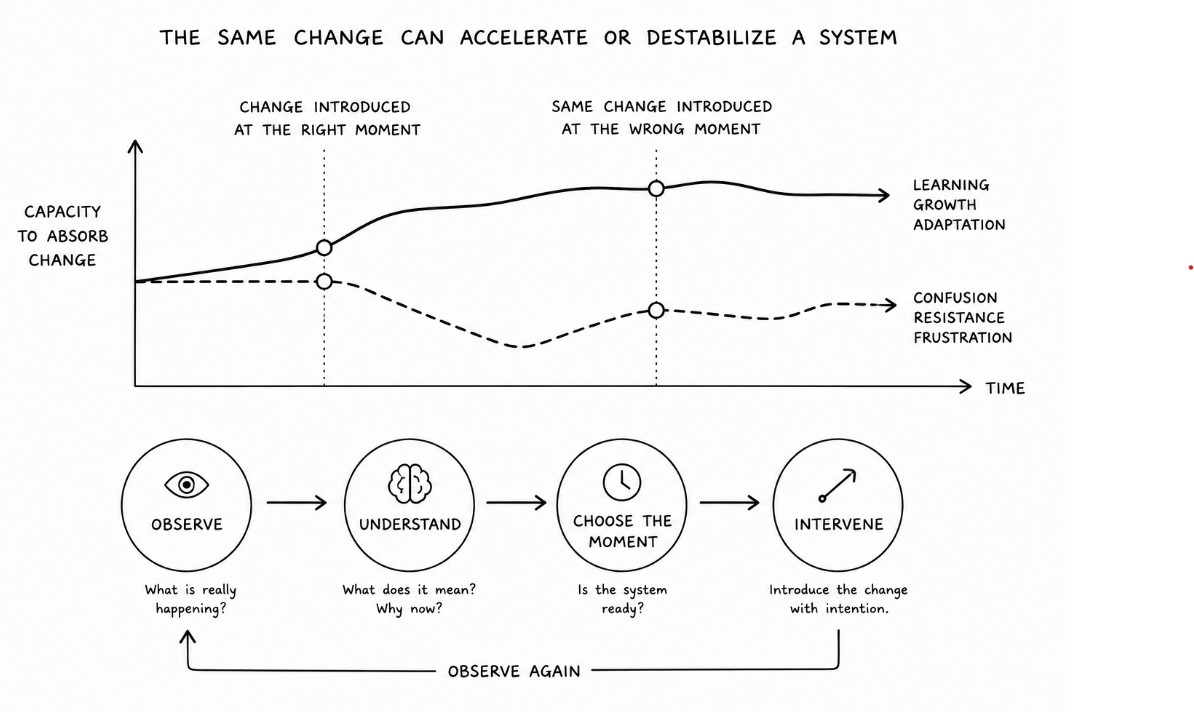
However, introducing change is not only about deciding what should change. It is equally about understanding when to introduce that change and, just as importantly, how to introduce it so the system is capable of absorbing it.
The same intervention can strengthen a team or destabilise it. The same idea can accelerate learning or create resistance, frustration and uncertainty—not because the idea itself is inherently good or bad, but because it is introduced at a different moment in the evolution of the system.
For this reason, I increasingly see change not as a project, but as the natural consequence of observation.
Observe. Understand. Recognise the current situation. Choose the right moment. Intervene. Then observe again.
The quality of an intervention depends not only on the solution itself, but also on the moment in which it is introduced.
Of course, not every organisation has the luxury of waiting for the perfect moment. Business priorities shift, markets evolve, regulations emerge and technology continuously forces transformation. Sometimes change is simply unavoidable.
In those situations, SAMM does not attempt to delay change. Instead, it helps us understand the current state of the system before intervening, allowing us to anticipate where change will be naturally absorbed, where resistance is likely to emerge and what consequences that intervention may produce.
Because even when change is inevitable, understanding the situation allows us to introduce it with greater awareness and minimise unnecessary disruption.
Observation requires a common language
One of the biggest misconceptions about SAMM is believing that it replaces existing methodologies.
It does not.
In fact, I believe every human system needs a common foundation from which it can evolve: a shared language, a minimum framework, common principles, regular feedback loops and a consistent way of working.
Not because the framework itself is the answer, but because it makes the system observable.
Without a common reference, it becomes extremely difficult to distinguish between normal variability and meaningful change. Without observability there is no shared understanding, and without shared understanding there can be no meaningful learning.
Frameworks such as Scrum, Kanban, XP or Lean should therefore not be seen as universal solutions. Instead, they provide something equally valuable: a stable baseline from which the behaviour of the system can be observed, understood and continuously improved.
Methodologies are not the destination.
They are the starting point.
They make the system visible.
Only then can Situational Awareness begin.
Evolution instead of optimisation
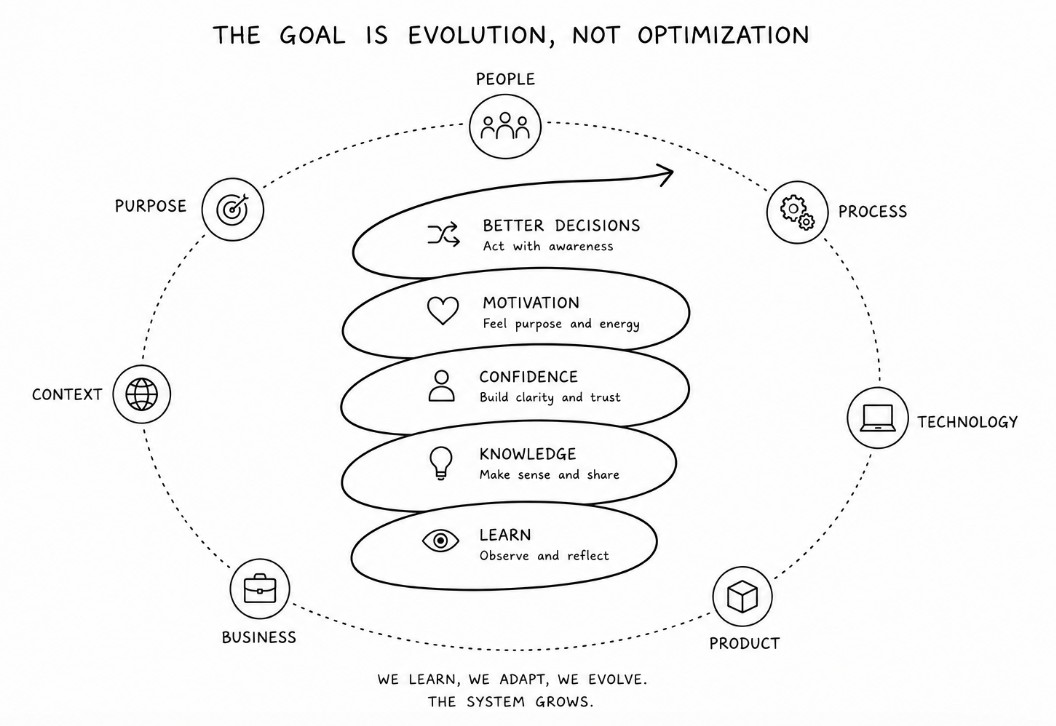
We often talk about optimising teams.
I increasingly prefer another word.
Evolution.
Great teams are not created because they adopt the perfect methodology. They emerge because they continuously learn, share knowledge, develop trust, deepen their understanding of the product and maintain the curiosity that allows them to adapt without losing cohesion.
Over time, knowledge stops belonging to individuals and becomes a property of the system itself. The team develops a shared language, shared intuition and better judgement, gradually becoming more capable of dealing with complexity.
The ultimate goal is not simply to make better decisions today. It is to increase the system’s ability to make better decisions tomorrow.
Sustainable systems do not depend on exceptional leaders. They progressively learn to understand themselves, recognise the challenges they are facing, identify their own strengths and limitations, and understand when they need structure, autonomy, stability or change.
That, to me, is the real meaning of organisational maturity: not eliminating uncertainty, but developing the collective capability to evolve through it.
True sustainability is not about preserving a process or protecting a methodology. It is about preserving the system’s ability to continue learning while everything around it keeps changing.
The purpose of SAMM
The Situational Awareness Management Model is built on a simple assumption:
Human systems continuously evolve.
If that is true, management decisions cannot remain static. Every intervention should begin by understanding the situation the system is currently experiencing.
Not because SAMM attempts to eliminate complexity.
Quite the opposite.
Complexity is a natural property of every human system.
The purpose of SAMM is to help leaders—and ultimately the systems themselves—develop the ability to observe, understand and respond consciously to that complexity. Not by optimising People, Process or Technology independently, but by understanding how these dimensions continuously interact throughout the life of the system.
SAMM emerged from years of leading software engineering teams. However, its principles extend far beyond software. Any knowledge-intensive organisation where people collaborate to solve complex problems faces the same challenge: not building better processes or adopting better tools, but continuously helping the system evolve while the world around it keeps changing.
Because before changing a process, introducing a new framework, redesigning a technology or reorganising a team, there is always one question that matters more than any other:
What situation is this system experiencing right now?