The Energy Behind Every Human System
Understanding why motivation drives the evolution of human systems.
In the previous articles we explored the complexity of human systems. We discussed People, Process and Technology as the three fundamental dimensions that shape every organisation, and we also discovered that human systems never remain static. People, technology, products, priorities, and situations continuously change.
Yet one fundamental question still remains unanswered:
What actually makes a human system evolve?
Processes organise work, technology enables it, and knowledge determines what people are capable of doing. But none of these explain why two apparently similar teams can produce completely different outcomes.
The difference is rarely found in the process or technology, and very often it is not even found in talent. It lies in the energy with which people approach the situation they are experiencing.
That energy has a name: motivation.
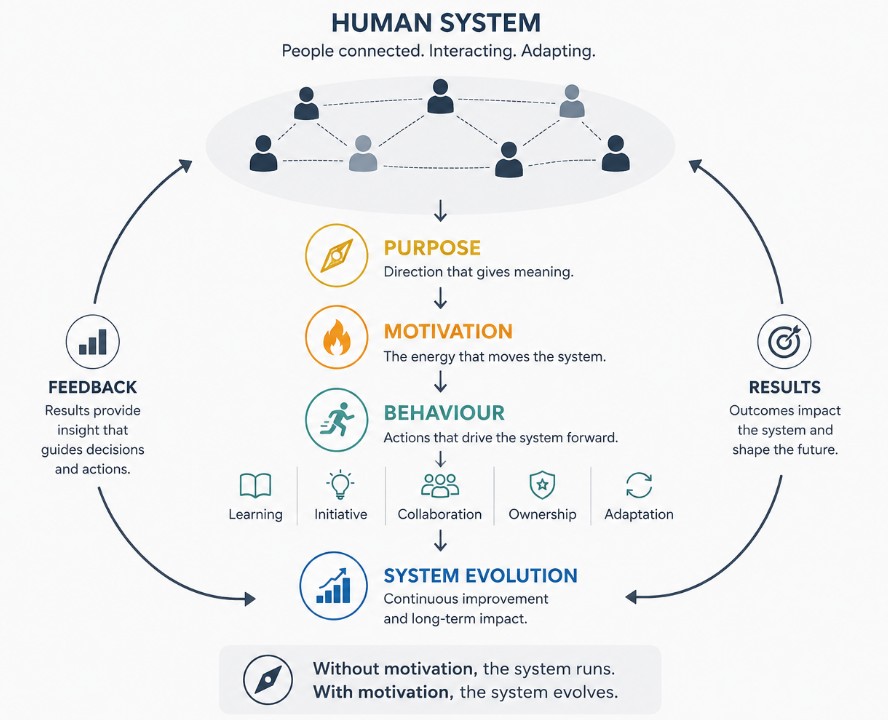
Every Human System Needs Energy
Every physical system requires energy to produce movement. Without energy, an engine remains still. Human systems are no different.
Knowledge does not generate behaviour. Processes do not create initiative, and technology does not create ownership. People transform potential into behaviour, and motivation is the energy that makes that transformation possible.
When motivation is high, behaviours emerge that no process can ever enforce. People learn, collaborate, experiment, share knowledge, help others and take ownership—not because somebody demanded it, but because the system has enough energy to evolve.
When that energy disappears, the opposite happens. Tasks are still completed, meetings still take place, processes continue running and products are still delivered. From the outside, everything appears normal, but internally something has changed: the system has stopped learning.
And a system that stops learning will eventually stop evolving.
Motivation Is Situational
We often describe people as motivated or unmotivated, but experience suggests that reality is far more dynamic. The same person may feel highly engaged in one project and completely disconnected in another, even though the individual has not necessarily changed. The situation has.
The project, the challenge, the leadership, the team, the level of uncertainty and the opportunities for learning all shape that situation in different ways. Motivation therefore cannot be understood as an isolated personal characteristic; it is also influenced by the situation.
For this reason, SAMM treats motivation as a situational variable. It does not attempt to measure how motivated a person is. Instead, it seeks to understand how much energy a person is bringing to the situation they are experiencing at that particular moment.
Because situations change continuously, motivation changes as well.
Knowledge Is Not Enough
Imagine two software engineers with similar experience and comparable technical skills, working on the same product and using the same tools. On paper, they look almost identical.
Yet one constantly looks for improvements, shares knowledge, helps colleagues, learns new technologies and suggests better solutions, while the other simply completes the assigned work correctly and professionally, but goes no further.
What explains that difference? Not knowledge, process, or technology, but motivation.
One sentence summarises this idea remarkably well:
Knowledge determines what someone can do.
Motivation determines what they choose to do.
Capability creates potential, motivation transforms that potential into behaviour, and behaviour transforms the system.
The Psychology Behind Motivation
SAMM does not attempt to redefine motivation. Instead, it builds upon well-established psychological theories that explain how motivation influences behaviour, two of which are particularly relevant.
The Flow State
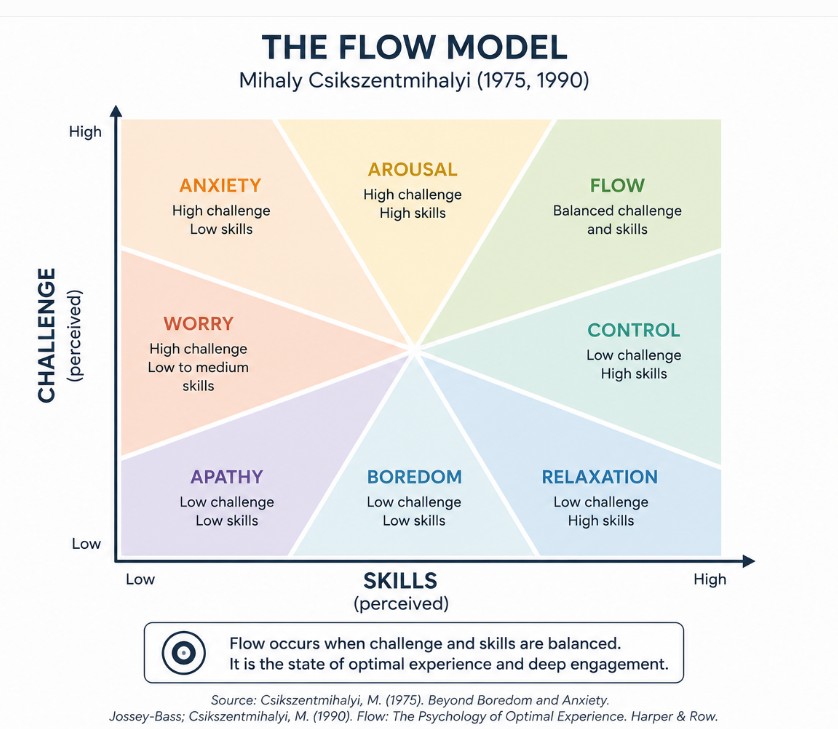
One of the most influential concepts in performance psychology is Flow, introduced by Mihaly Csikszentmihalyi.
Flow describes the mental state where people become fully immersed in an activity. In this state, learning accelerates, attention becomes effortless, and performance naturally improves.
Flow emerges when challenge and capability remain balanced. If the challenge is too low, boredom appears; if it becomes excessive, anxiety replaces learning.
For managers, this idea changes the meaning of leadership. Leading is not only about assigning work, but about continuously adjusting challenges so people remain capable of learning without becoming overwhelmed.
The Right Amount of Pressure
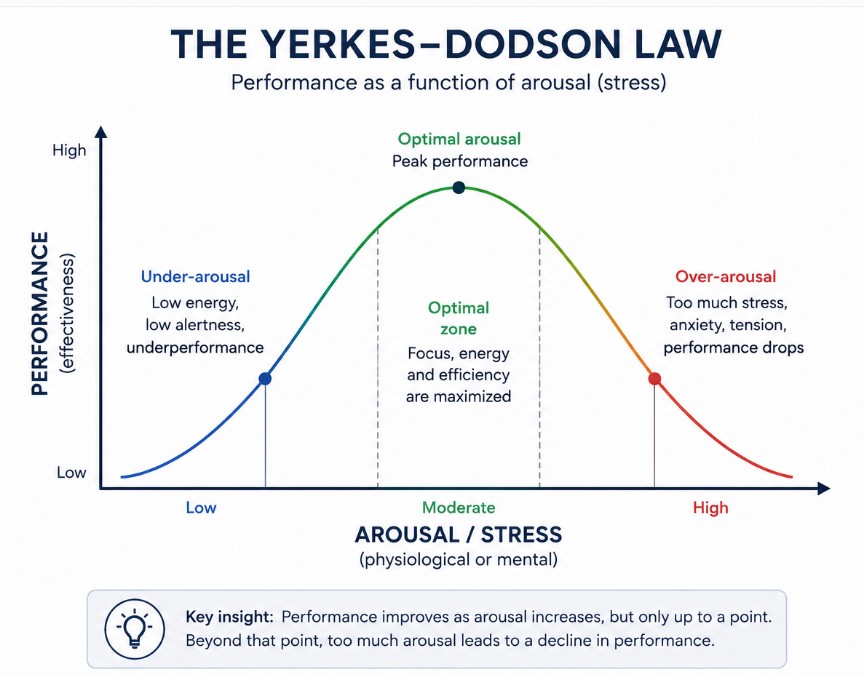
Another psychological principle complements this idea: the Yerkes–Dodson Law.
Performance does not increase indefinitely with pressure. Too little pressure often leads to disengagement, while excessive pressure eventually produces stress. Between these two extremes lies the optimal zone where performance and learning coexist.
Software engineering provides excellent examples. Too little challenge creates comfort, whereas too much pressure destroys curiosity. People stop experimenting, knowledge sharing declines and decisions become increasingly reactive.
The objective of leadership is therefore not to maximise performance, but to create the conditions where learning can continue sustainably.
Purpose Gives Direction. Motivation Provides Energy. Discipline Sustains It.
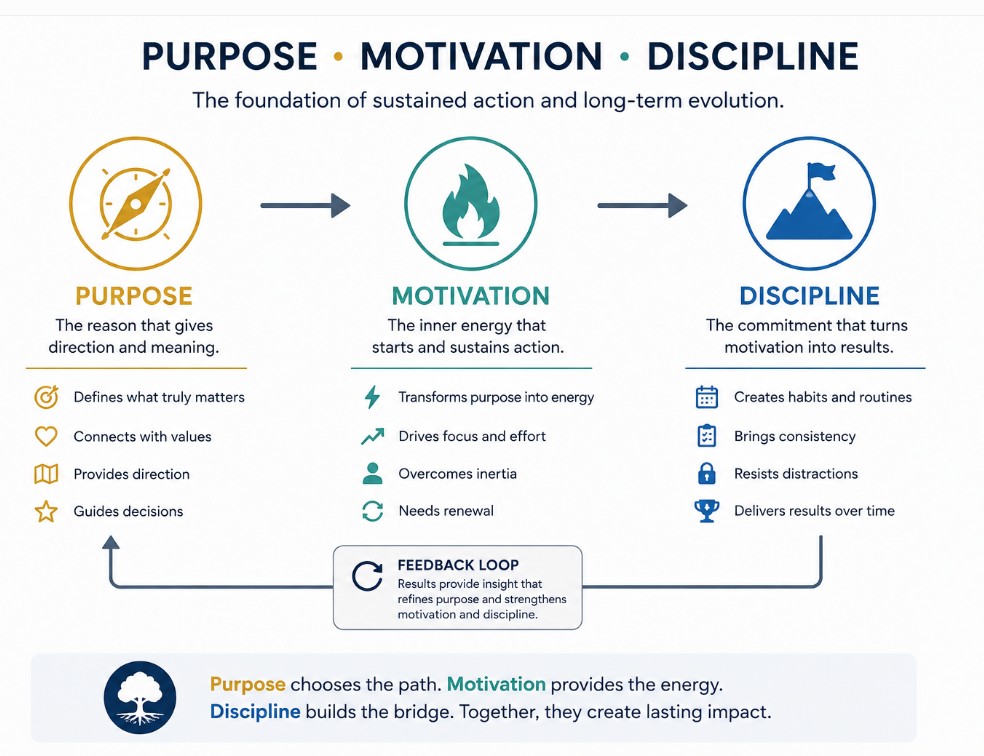
Motivation is essential, but motivation alone is not enough. No one remains highly motivated every single day. Some tasks are exciting; others simply need to be done.
That is precisely where discipline becomes indispensable. It builds habits, creates consistency and allows progress even when motivation naturally fluctuates. But discipline cannot exist without direction: without purpose, discipline eventually becomes routine, while without motivation, consistency slowly turns into compliance.
Purpose provides direction, motivation provides energy, and discipline sustains movement. Together, they transform isolated moments of enthusiasm into long-term evolution.
A team does not evolve because it is constantly motivated, nor because it is merely disciplined. It evolves because discipline allows people to continue moving toward a purpose they genuinely believe in.
Behaviour Is a Consequence
When a team begins to struggle, managers often try to change behaviour directly by introducing more rules, more meetings, more reporting or more control. Sometimes these interventions work, but often they do not, because behaviour is usually not the origin of the problem. It is merely its consequence.
Behind behaviour lie much deeper variables: purpose, motivation, trust, autonomy, psychological safety and, ultimately, the current situation.
The visible problem rarely originates where it becomes visible.
Observe Before You Intervene
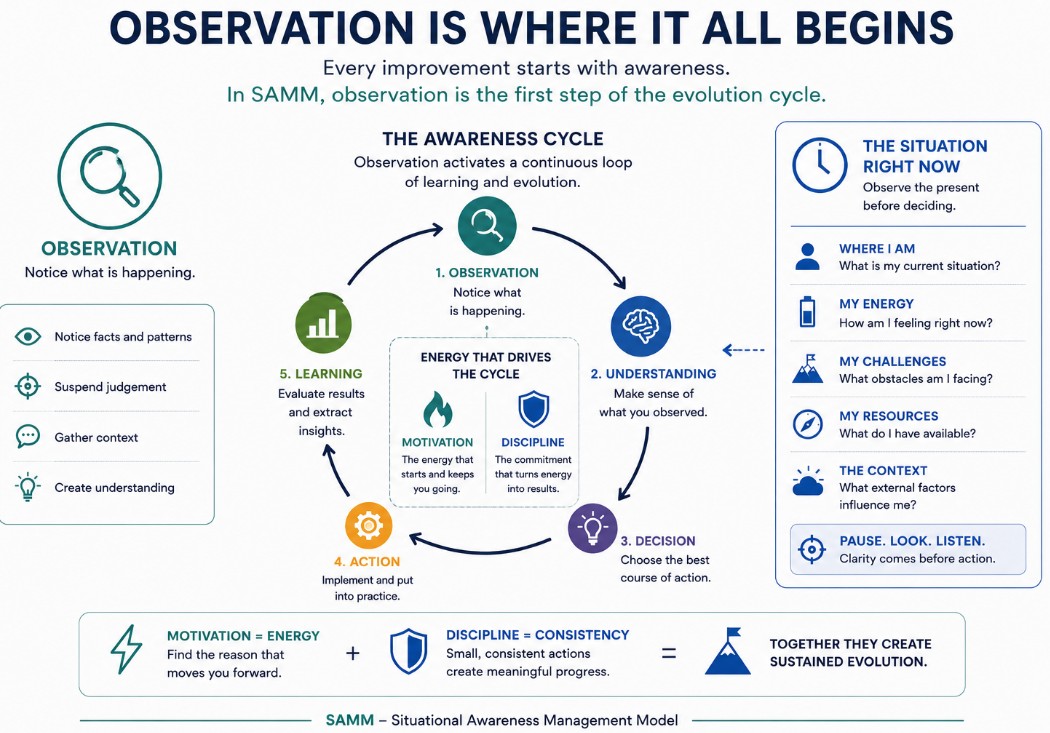
If motivation depends on the situation, and behaviour depends on motivation, then leadership begins by understanding the situation before deciding how to act. This is one of the fundamental principles behind SAMM.
It is not enough to observe tasks or measure results. Leaders need to understand how people are responding to the situation they are experiencing, because only then can behaviour be interpreted correctly.
Observation is the foundation of Situational Awareness: only what becomes observable can become understandable, and only what becomes understandable can be intentionally improved.
Demotivation as a System Signal
Although people, processes, and technology continuously influence one another, my attention as an observer naturally gravitates toward people.
A motivated person will often compensate for imperfect processes and limited or overly complex technology. A demotivated person, however, gradually degrades both. Ownership fades, shortcuts become acceptable, technical debt grows, and the energy of the system slowly disappears.
When I detect sustained demotivation, my priority is not to change processes or technology, but to understand why that energy has been lost. While working to restore it through empathy, trust, and new challenges, I also try to protect the system. Sometimes this means temporarily redistributing responsibilities—not as a punishment, but as a way to protect both the person and the system while the underlying causes are addressed.
Protecting the energy of those who remain motivated is equally important. No system should depend indefinitely on the extra effort of a few people to compensate for inefficient processes or inadequate technology. That energy is finite.
In my experience, the most valuable feedback for evolving a system often comes from the person who has lost the most energy—provided they feel safe enough to speak honestly.
That feedback often reveals unnecessarily complex processes, technical decisions that have become normalized, or ways of working that no longer add value. Listening, however, is only the beginning. It should trigger a conscious evolution of the system: simplifying processes, reducing technical debt, improving tools, or rethinking the way people collaborate. Energy is not what the observer tries to change; it is what reveals what needs to change.
The observer’s responsibility is not only to interpret that energy, but also to make it visible so others can learn to observe it as well. A healthy system does not depend on a single observer; it continuously develops new observers who can recognize the same signals and act upon them.
Finally, it is worth remembering that the observer is also part of the system. Our own energy shapes what we notice and how we interpret it. Whenever I notice a significant change in my own energy—whether through frustration, stress, excitement, or fatigue—I try not to react immediately. Instead, I observe myself with the same curiosity I apply to the system.
Because sometimes the system does not need to change. The observer does.