Attention Is All You Need: From Situation to Intervention
Turning Situational Awareness into conscious intervention.
Throughout the previous articles, we have gradually built the different pieces of the Situational Awareness Management Model.
We introduced the Situational Map to recognise what a human system is experiencing, and the Situational Process to transform that understanding into conscious intervention.
Now it is time to bring both together.
Recognising a situation has limited value if that understanding does not help us answer a fundamental question:
Once we understand the situation, where should we focus our attention and how should we intervene?
This is the purpose of the SAMM Intervention Roadmap.
From Situation to Attention
Each situation represents a different moment in the evolution of the system and therefore requires a different focus from leadership.
At Cruising Speed, stability creates space for learning, developing capabilities and discovering opportunities. During Fluctuation, emerging signals need to be observed and understood before reacting. Indirection requires recovering purpose and making decisions about direction, while under Pressure, attention naturally shifts towards deciding and acting. Finally, Stabilization creates an opportunity to absorb what has happened, consolidate change and transform experience into learning.
SAMM connects these moments with the OODA Loop, highlighting the phases where leadership attention may create the greatest value.
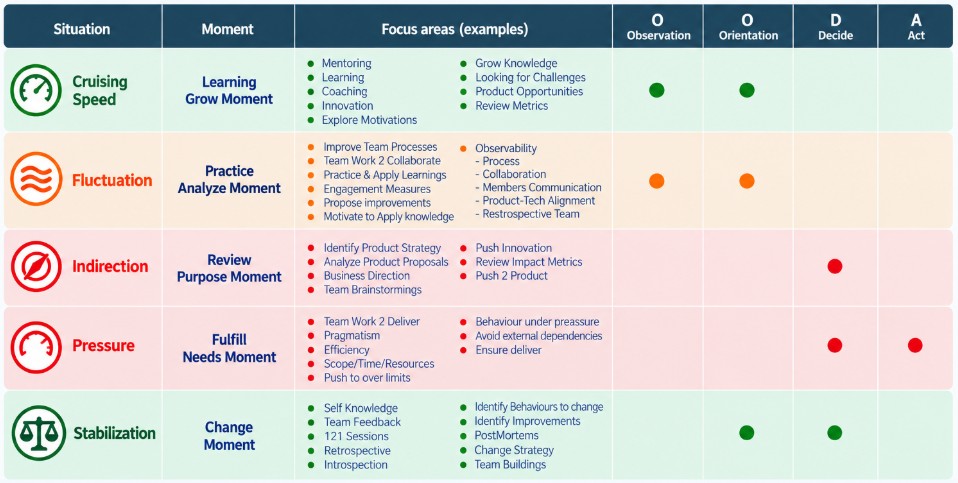
The matrix does not mean that some phases of OODA disappear depending on the situation. Observe, Orient, Decide and Act remain part of a continuous loop.
What changes is their emphasis.
The situation does not change the OODA Loop. It changes where our attention should be.
A leader supporting a team under Pressure still needs to observe and understand what is happening, but cannot remain indefinitely analysing the situation. Decisions need to be made, obstacles removed and execution enabled.
At Cruising Speed, however, the absence of urgency creates more space to observe the system, understand people, identify opportunities and anticipate future needs before deciding whether intervention is even necessary.
The loop remains the same. The focus moves as the situation evolves.
From Attention to Intervention
Knowing where to focus our attention still does not tell us exactly what to do.
The next layer of the roadmap connects the different phases of OODA with possible leadership interventions.
During Observation, the leader may explore metrics, team dynamics, technical signals, motivation or knowledge distribution. During Orientation, the objective moves from collecting information to giving it meaning through conversations, retrospectives, 1:1s or other spaces that help build a deeper understanding of the system.
When attention moves towards Decision, understanding needs to become choice: priorities may need to change, capacity may need to be protected or existing assumptions may need to be challenged. Finally, Act transforms those decisions into movement by removing obstacles, reducing unnecessary complexity or directly supporting the team when the situation requires it.
These activities are not intended to become a checklist. They are possible interventions whose value depends on the situation.
Not Only What to Do, but How to Intervene
Choosing an intervention introduces another important decision: how should the leader intervene?
This is where the Push/Pull Continuum becomes part of the roadmap.
SAMM does not assume that good leadership should always be directive, nor that it should always be facilitative. The nature and intensity of an intervention should also adapt to the situation.
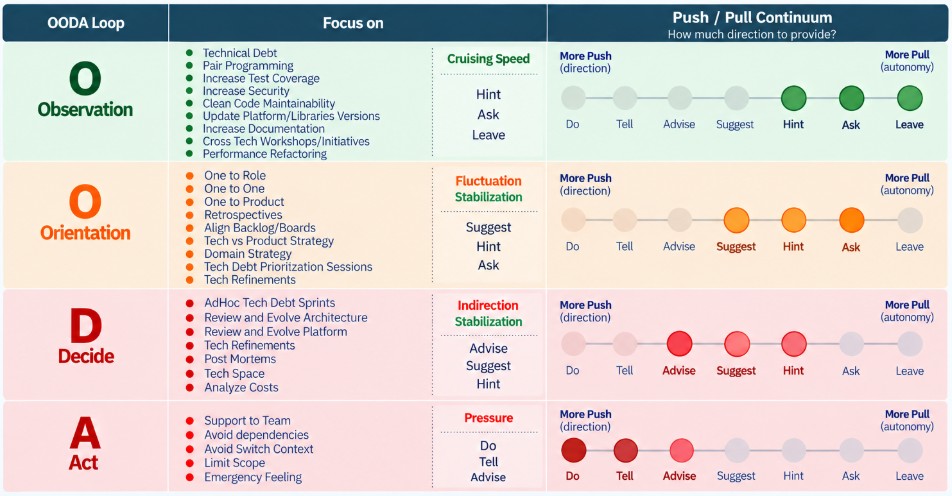
Towards the Push side of the continuum, leadership provides progressively more direction through approaches such as Do, Tell or Advise. Moving towards Pull, responsibility progressively returns to the system through Suggest, Hint, Ask or Leave.
At Cruising Speed, there is usually more space to ask questions, suggest possibilities or allow the team to discover its own solutions. The objective is not to solve problems that the system already has the capability to solve.
Under Pressure, however, a more direct intervention may be appropriate. During a critical incident or severe constraint, providing direction, making a decision or directly removing an obstacle may be exactly what the team needs.
Neither side of the continuum is inherently better.
Sometimes Ask is the right intervention. Sometimes Tell is. The situation determines the difference.
Adaptive leadership means being able to move consciously along that continuum as the needs of the system change.
Intervention Also Means Learning
Intervention does not end the process.
Every intervention changes the system we were observing. A decision may change priorities, a conversation may influence behaviour and a new practice may transform the way people collaborate. The situation after an intervention may therefore be different from the one that originally triggered it.
This is where SAMM incorporates the principle of continuous feedback and improvement inspired by Six Sigma.
The objective is not to execute a formal DMAIC cycle after every leadership decision. Instead, SAMM preserves its underlying discipline: understand what we are trying to improve, observe the effects of the intervention, analyse what has changed and use that learning to adapt what happens next.
An intervention should therefore be understood less as a definitive solution and more as a hypothesis about how to help the system evolve.
Every intervention creates new information about the system.
That information becomes feedback, feedback becomes learning, and learning changes the way we understand the next situation.
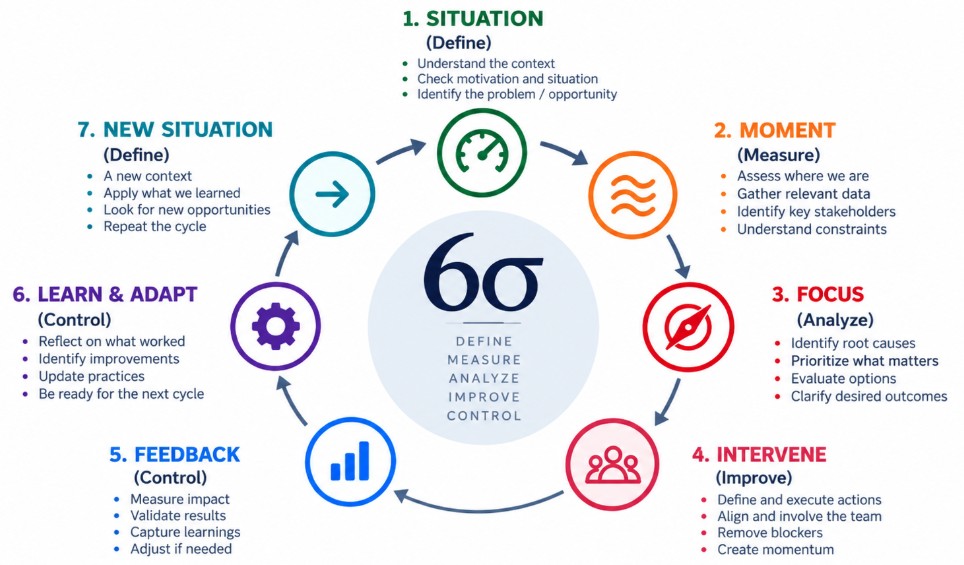
We observe the system, understand what it needs, choose where to focus our attention and decide how to intervene. We then observe the consequences and use that information to understand the system again.
There is no final state. There is only continuous adaptation.
From the Model to Practice
Once this series has completed the foundations of SAMM, we will translate them into a simplified and practical way of working with the model. We will explore how to identify situations, work with SAMM collectively with the team and individually with each person, define meaningful interventions, follow their effects and use continuous feedback to support both individual and team development.
The objective is not to introduce new ceremonies or add another layer of management bureaucracy. SAMM should provide a lightweight structure that can coexist with the conversations, 1:1s, retrospectives and working practices teams already use.
Understanding the model requires depth.
Using it should remain simple.