The Situational Map
The Situational Map is the heart of SAMM. Understanding systems through the situations they experience. Every observation, every conversation and every evolution strategy begins here.
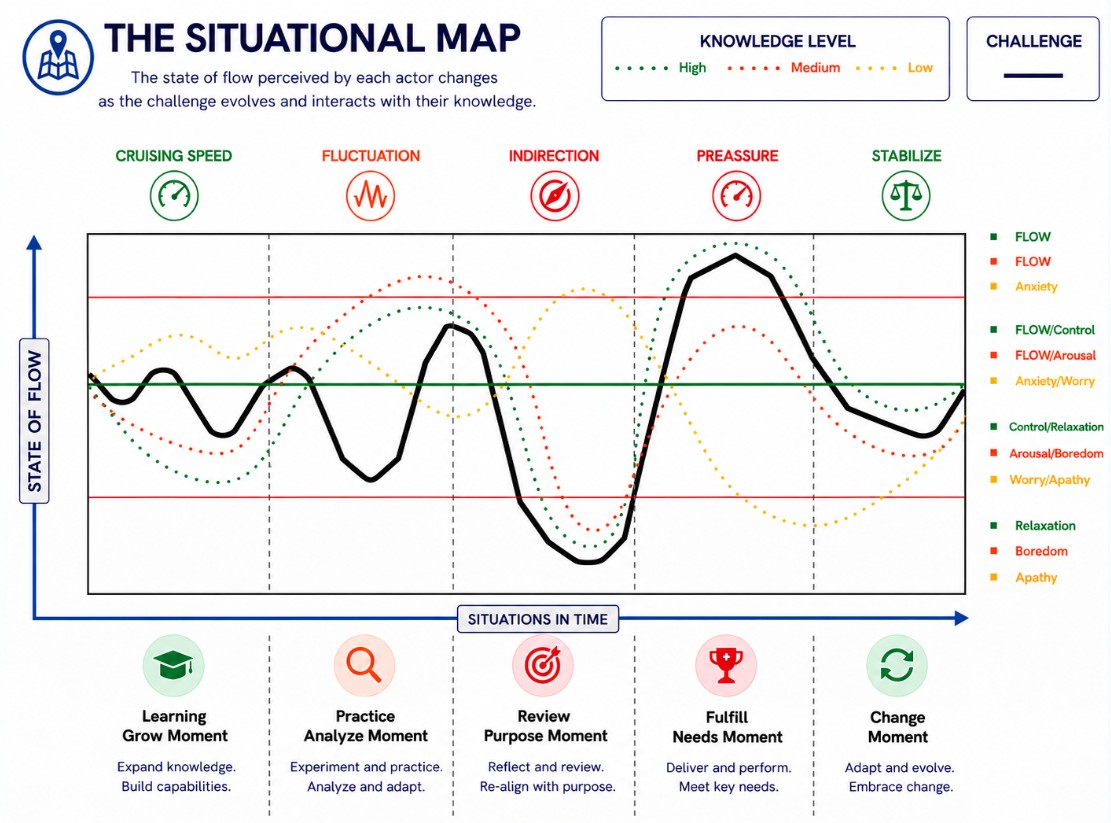
Human systems do not evolve only because people change. They evolve because situations enable change.
For decades, we have tried to understand human systems by observing people. We assess competencies, evaluate performance, measure productivity and improve processes, yet the same team may respond very differently as its situation evolves, even when the people remain exactly the same.
What has changed is the situation experienced by the system.
This is the foundation of the Situational Map: an observational model that helps us understand the system’s current situation before attempting to interpret it or intervene.
A reorganisation, a new technology, a demanding customer or a tight deadline are not situations; they are events. A situation emerges when those events change the level of challenge experienced by the system, which means the same event may generate completely different situations in different teams.
The Situational Map does not classify events. It classifies the situations they create.
Situations are not sequential stages. A system may move between them, remain in one for several observation cycles, or return to previous situations as its context evolves.
Everything else in SAMM builds upon this shared situational understanding. The Situational Map generates hypotheses, not absolute answers, which are progressively validated through observation, conversations and information gathered from situational sensors.
Like every observational model, its purpose is to help us understand what is actually happening before deciding what to do next. Better understanding leads to better decisions, and better decisions allow human systems to evolve sustainably.
Although the examples throughout this article focus on professional environments, the Situational Map was never designed exclusively for organisations. Families, sports teams, volunteer communities, educational environments, friendship groups, startups and large enterprises all experience situations. While those situations differ, the principles of observation remain remarkably consistent because the model focuses on the relationship between challenge, knowledge and energy rather than organisational structures.
Challenge, Knowledge and Flow
Every situation represented in the Situational Map corresponds to a particular level of challenge, but challenge can never be interpreted in isolation. Its effect depends on the knowledge available within the system.
This principle is consistent with Mihaly Csikszentmihalyi’s theory of Flow, explained in The Energy Behind Every Human System. According to Flow theory, engagement emerges when challenge and capabilities remain in balance. Too little challenge leads to boredom, while excessive challenge generates anxiety.
The same level of challenge may therefore produce completely different situations depending on the knowledge available within the system. The Situational Map combines challenge and knowledge to describe the situation experienced by a system and the resulting energetic state of the whole system.
The observer’s objective is not to keep the system in a particular situation, but to help it evolve sustainably over time. Through appropriate observation and interventions, they seek to create the conditions in which as many actors as possible can remain close to their own state of Flow, regardless of the situation the system is experiencing.
The map is not a timeline. The wave does not represent time; its amplitude represents common changes in the level of challenge experienced by the system. A system may revisit previous situations, alternate between them, or remain in the same situation for several observation cycles.
The Five Situations
The Situational Map proposes five situations that describe different relationships between challenge and knowledge. Together, they provide a shared observational language for understanding how human systems evolve.
Identifying the current situation also helps anticipate its likely impact on the energy of its actors and, ultimately, on the behaviour of the system itself. The model therefore describes tendencies and probabilities rather than fixed thresholds or absolute certainties.
Future articles will explore their dynamics, transitions and practical implications in much greater depth.
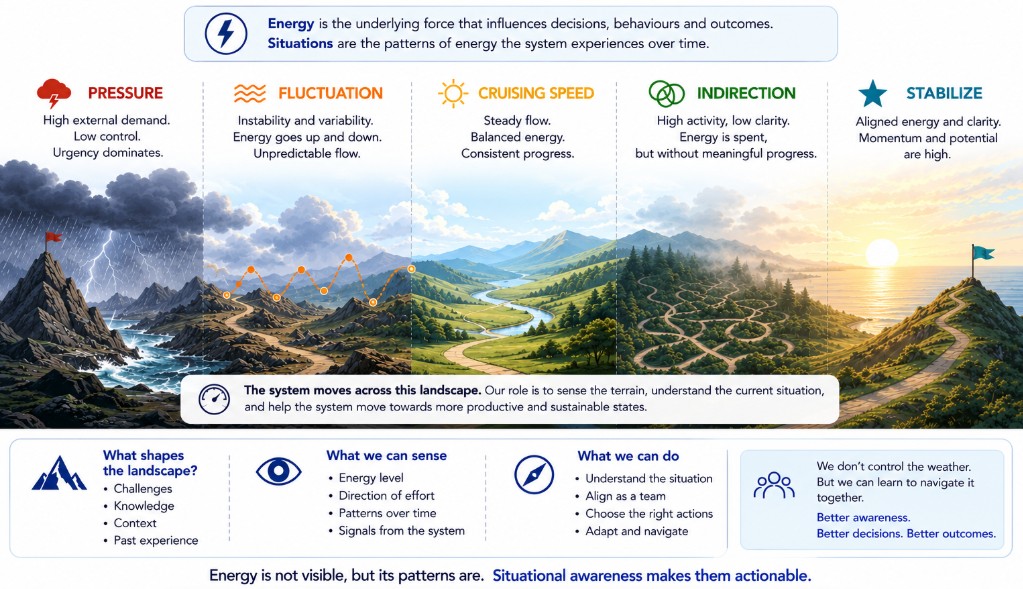
Cruising Speed
Cruising Speed represents a healthy balance between challenge and knowledge. The system operates at a sustainable pace, understands its objectives and still has enough capacity to continue growing without compromising its energy.
This is a Learning & Growth Moment. The system has enough stability and available energy to expand its knowledge, develop new capabilities and explore new challenges. For example, the team may learn a new technology, experiment with a different engineering practice or help its members grow into new responsibilities.
Fluctuation
Fluctuation appears when challenge begins to increase. The system starts adapting to new circumstances, learning accelerates and energy may temporarily fluctuate while equilibrium is maintained.
This is a Practice & Analysis Moment. The system needs opportunities to practise what it is learning and observe how it responds to the new challenge. For example, a team adopting a new delivery model may run small experiments, analyse their results and adjust its practices before applying the change more broadly.
Pressure
Periods of Pressure are often necessary for learning, innovation and exceptional performance. They provide direction, reveal the system’s limits and create opportunities to expand its capabilities.
The observer’s role is not to eliminate pressure, but to channel the system’s energy towards eustress, the positive form of stress described by Hans Selye. The risk appears when pressure is sustained for longer than the system can support, progressively increasing the probability of exhaustion, reduced quality and loss of adaptability.
This is a Fulfil Needs Moment. Pressure is the moment to mobilise all the knowledge, capabilities and support available within the system. The immediate priority is to remove anything that prevents the system from responding to the challenge and satisfying the needs of the moment. This is the moment of truth: the system acts, adapts and demonstrates what it is truly capable of achieving.
Indirection
Sometimes the greatest challenge is not excessive workload but the absence of direction. The system possesses enough capability to move forward, yet lacks sufficient clarity about where to focus its effort. As a consequence, energy becomes dispersed and the collective potential of the system is only partially realised.
This is a Review Purpose Moment. The system needs to reconnect its activity with a meaningful and shared purpose. For example, the team may review why a product exists, clarify the outcome it is trying to achieve or reconsider priorities that no longer contribute to its goals.
Stabilization
Following sustained periods of challenge, systems require time to consolidate learning and recover equilibrium. Stabilization represents that recovery process, allowing energy to rebalance before new challenges are introduced.
Its purpose is not to stop evolving, but to ensure that future evolution remains sustainable.
This is a Change Moment. The system has an opportunity to incorporate what it has learned and make the changes required to establish a new sustainable balance. For example, it may redesign responsibilities, simplify a workflow, modify team agreements or adopt a different operating rhythm before facing the next challenge.
Situational Energy
One of the fundamental principles of SAMM is the distinction between situations and energy: situations belong to systems, while energy belongs to people.
The same team may be experiencing Pressure, while each individual responds differently. Some may perceive the challenge as motivating, while others begin to experience fatigue; some increase their contribution, whereas others progressively disengage. The situation is shared, but the energy is individual.
This distinction is essential because energy does not belong exclusively to work or personal life. It belongs to the individual and accompanies them across every system in which they participate.
A professional system experiencing sustained Pressure may therefore reduce the energy that the same person brings into family life. Likewise, prolonged Indirection in someone’s personal environment may reduce the energy they contribute to their professional system.
For this reason, the Situational Map never classifies people. People contribute their energy to the system, while situations describe the context in which that energy is expressed.
This also explains why behavioural changes cannot always be understood by observing a single system. Sometimes the origin of an observable change lies outside the system currently being observed. By recognising that energy naturally flows across every system in which people participate, SAMM provides a more complete understanding of human behaviour.
Situational Observation Window
Human systems are dynamic. Their behaviour fluctuates, unexpected events occur continuously, and people naturally have good and bad days. If observation is limited to isolated moments, almost any diagnosis becomes unreliable.
For this reason, SAMM recommends observing situations over cycles of approximately two to four weeks. This cadence aligns naturally with Scrum iterations, Kanban review cycles or XP feedback practices, while usually providing enough information to distinguish temporary fluctuations from genuine situational changes.
More importantly, it creates enough time for observation, conversation and intervention to become part of the same continuous learning cycle.
This recommendation should not be interpreted as a rigid rule. Some systems evolve much faster and others require longer observation periods. The important principle is not the exact duration, but observing the system long enough to reveal meaningful patterns rather than isolated events.
Situational Sensors
Observation requires evidence. SAMM introduces situational sensors as observable signals that provide evidence about both the system and its actors. Their purpose is not to measure organisational success, but to reveal behavioural patterns that help observers understand how the system may be evolving.
No individual sensor can determine a situation. During the observation window, the observer combines evidence gathered through situational sensors with their own observations, one-to-one conversations, team discussions and alignment sessions. Assumptions are progressively validated or challenged until a shared understanding of the situation begins to emerge.
Situations therefore do not emerge from sensors alone, but from the collective interpretation of evidence accumulated over time. This is why trust, cohesion and honest dialogue are fundamental to SAMM: shared understanding emerges from shared evidence, openly discussed.
To learn more about the sensors used to observe both the system and its actors, see:
- Understanding Human Systems (I): Attributes of System Actors
- Understanding Human Systems (II): Technical and Evolutionary System Capabilities
Situational Memory
Observation never begins from zero. Every system carries a memory of the situations it has previously experienced, which means two teams may appear to be in exactly the same situation today yet evolve very differently because they arrived there through different paths.
One team may have recently recovered from several months of sustained Pressure, while another may have gradually evolved from Cruising Speed through a brief period of Fluctuation. Although their current observations may appear similar, their histories are fundamentally different.
SAMM refers to this accumulated history as situational memory. The current situation explains where the system is, while situational memory explains how it arrived there and influences how it is likely to respond next.
Without this historical perspective, identical observations can easily be mistaken for identical problems. Imagine two teams currently experiencing Pressure: one has maintained healthy rhythms for months before entering this situation, while the other has already spent several months under sustained overload. Additional challenge may still feel stimulating to the first team but overwhelming to the second.
Situational memory therefore helps explain why identical interventions can produce different outcomes.
This principle is consistent with Martin Seligman’s work on Learned Helplessness. When individuals repeatedly experience situations where their actions appear unable to change outcomes, they gradually reduce initiative, experimentation and engagement. Even after external circumstances improve, behaviour may take much longer to recover.
Human systems can behave similarly. A team that remains under prolonged Pressure or extended Indirection does not necessarily recover immediately when the situation changes, because its previous experience continues shaping how new situations are interpreted.
Changing the context is often necessary, but it is rarely sufficient by itself.
This is why SAMM never evaluates the present in isolation. Every observation is interpreted through the system’s situational memory.
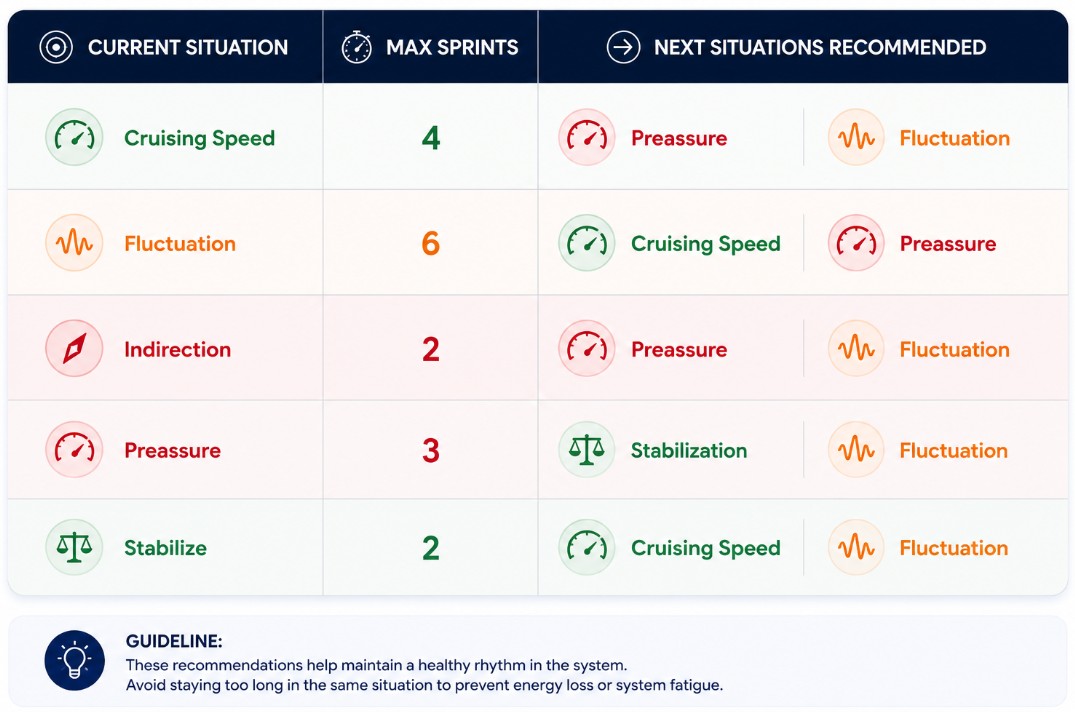
The recommendations shown in this diagram should never be interpreted as fixed rules. Human systems do not evolve according to predetermined schedules; instead, they represent practical guidance derived from observation.
Remaining too long in Pressure progressively increases the probability of fatigue, while remaining too long in Indirection may reinforce uncertainty and loss of purpose. Likewise, entering Stabilization after sustained challenge should not be interpreted as slowing down, but as part of sustainable evolution.
The objective is not to force systems through situations, but to avoid becoming trapped within them.
Situational Intervention
One of the fundamental principles of SAMM is that observation always precedes intervention. This may seem obvious, yet many organisations instinctively do the opposite: a team appears overwhelmed, so additional processes are introduced; communication deteriorates, so more meetings are scheduled; delivery slows down, so pressure increases; or motivation declines, so new incentives are designed.
The intervention itself is not necessarily wrong. The problem is that it may be based on an incomplete understanding of the situation.
The earliest signs of system degradation rarely appear in delivery metrics. As collective energy decreases, communication, collaboration and commitment gradually deteriorate, while technical quality declines as shortcuts accumulate into technical debt.
This degradation is usually subtle. An experienced engineer does not suddenly become less capable. Instead, lower energy influences countless small decisions: less attention to detail, fewer refactorings, postponed improvements and compromises that would previously have been challenged. Delivery velocity may remain apparently stable while the system silently consumes the energy that makes that performance sustainable.
For this reason, some of the most valuable observations come from conversations rather than metrics. Actors with low energy can provide valuable descriptions of the situations they are experiencing, while highly engaged actors may reveal how sustaining their performance is gradually becoming exhausting.
Traditional management often attempts to change the system by changing the people instead of understanding the situation they are experiencing. Teams are reorganised or managers replaced in the hope that different people will produce different outcomes. While this may temporarily alter the system’s energy, it rarely changes the situation itself.
SAMM proposes a different approach. Before deciding what should change, it asks:
What situation is this system actually experiencing, and how did it get here?
Only then does a more useful question emerge:
What does this situation need next?
The answer is never treated as certainty. Human systems are too complex for deterministic models, so SAMM generates situational hypotheses that become progressively stronger through observation.
The Yerkes-Dodson law, discussed in The Energy Behind Every Human System, shows that performance does not increase indefinitely as challenge grows. Beyond a certain point, additional challenge reduces performance instead of improving it.
SAMM extends this principle by recognising that the appropriate level of challenge depends not only on the system’s current situation, but also on its situational memory. Two systems displaying similar behaviour today may therefore require completely different interventions: one may benefit from additional challenge, while the other may first require recovery.
Only when sufficient confidence has been achieved does intervention become meaningful. Because every intervention depends on both the current situation and the system’s situational memory, there are no universal solutions.
The diagram below illustrates the default SAMM operational loop. Observation generates hypotheses, conversations strengthen or challenge them, and alignment builds shared understanding. Interventions then generate new observations that enrich the system’s situational memory and begin another iteration.
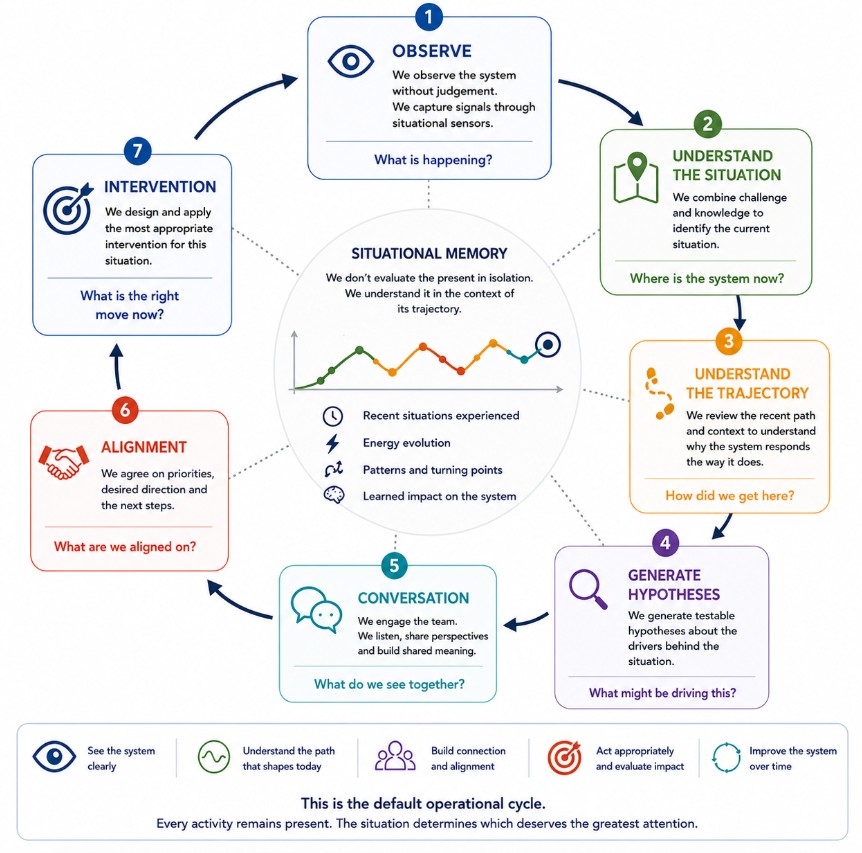
The operational loop remains the same; what changes is where attention should be focused. A system experiencing Pressure rarely benefits from the same actions as one experiencing Indirection, just as a system in Stabilization should not be managed like one operating at Cruising Speed.
Rather than prescribing universal solutions, SAMM continuously refines its understanding of the system and adapts its recommendations to the situation being observed.
Next
The following articles explore each situation in detail, explaining its characteristics, how it affects the system and how to adapt processes, practices and leadership accordingly. Each article also identifies the recommended attentional focus to help influence the system’s evolution.
Stay tuned… We’re just getting started. 😉
Your feedback is always welcome. If you have questions, different perspectives or experiences applying these ideas, I’d love to hear from you. Every conversation helps refine SAMM.