Common SAMM Practices
SAMM was born as a situational and adaptive model. Its purpose is not to define a leadership style or tell a lead exactly how to act in every situation.
Two leaders may observe the same situation and respond differently depending on the context, the people involved, their experience, and their own leadership style.
SAMM provides something that comes before that decision: a structured way to understand the situation we are leading.
SAMM provides situational awareness, not leadership recipes.
The model goes back to the essence that makes any value delivery possible: people, their motivation, their growth, and their ability to perform at their best.
The following practices represent the recommended starting point for SAMM, not a collection of mandatory ceremonies.
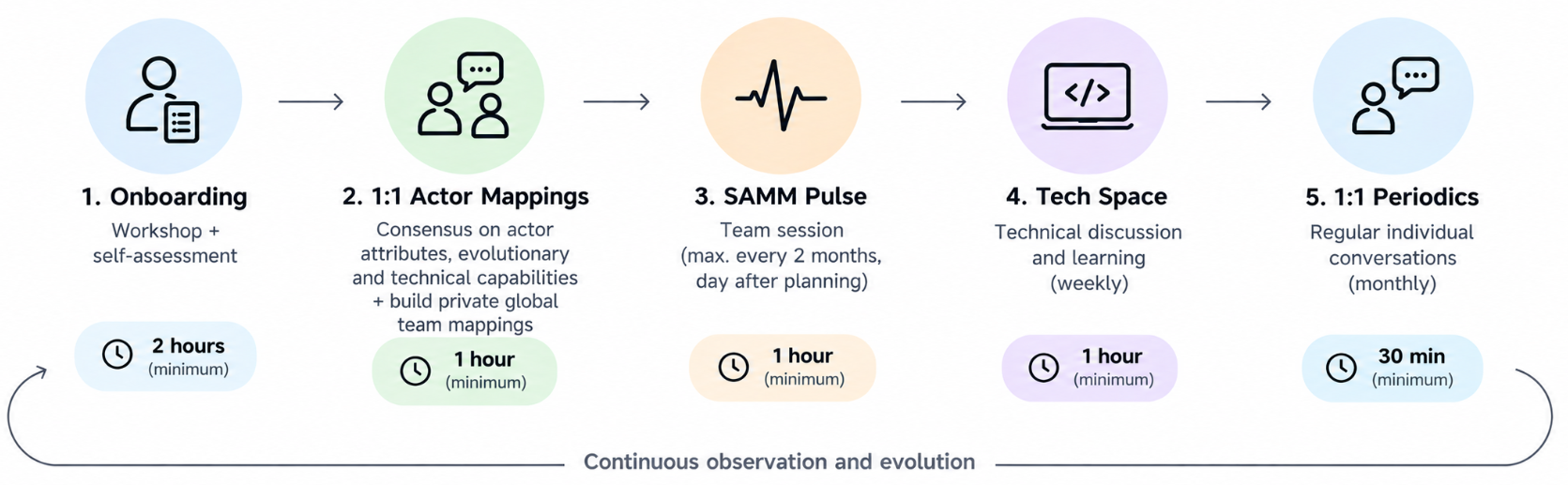
1. SAMM Foundations
SAMM assumes a system where iterative value delivery and established dynamics of collaboration, communication, and feedback already exist.
It does not require a specific framework and can coexist with Scrum, Kanban, Crystal, or other approaches.
SAMM recommends following Agile principles, with particular attention to Extreme Programming (XP) because of its focus on technical excellence, continuous feedback, shared knowledge, and collective ownership.
SAMM does not aim to replace these delivery mechanisms. It focuses on observing and helping evolve the human system that makes them possible.
SAMM begins where the delivery framework ends: in the human system that makes value delivery possible.
2. SAMM Onboarding
Before observing a system, we need a shared language about what we are going to observe and why.
Onboarding establishes that language and generates the first self-observations that will later be used to build the initial representation of the system.
2.1. SAMM Workshop
SAMM adoption begins with a workshop where the team is introduced to the essential concepts required to work with the model:
- SAMM & Situational Map: the purpose of the model and its proposed situations.
- Human Systems & Observer Theory: understanding the team as a human system and how different observers may perceive the same reality differently.
- Motivation & Psychological Foundations: concepts related to motivation, challenge, learning, frustration, growth, and performance.
- Human Representation: Actor Attributes and their purpose.
- System Capabilities: Evolutionary and Technical Capabilities.
- Situational Process: recommended foundations for moving from observation to intervention, including concepts such as OODA Loop, Push/Pull, feedback loops, continuous improvement, and Six Sigma.
- Situational Tech Debt Behaviour: technical debt management and continuous technical improvement.
- SAMM Intervention Roadmap (from situation to intervention): technical debt management and continuous technical improvement.
- Common SAMM Practices: how the evolution of the system will be observed over time.
SAMM uses these mechanisms as tools for reasoning and adaptation, not as rigid processes.
The workshop does not aim to explain each theory in depth. Each concept can be explored through its corresponding SAMM content.
Its purpose is to establish a shared language and common principles before we begin observing ourselves as a system.
2.2. Actor Self-Observation
After the workshop, the first observation begins.
SAMM recommends an individual self-observation questionnaire where each member describes how they currently perceive themselves through the Actor Attributes:
- Role & Knowledge Level: Low / Medium / High
- Mindset: Fixed / Growth
- Frustration Tolerance: Low / Medium / High
- Learning Shape: I-Shape / T-Shape
At this point, we are not looking for consensus or a definitive observation.
We are looking for self-perception: how each person currently observes themselves within the system.
2.3. Capabilities Self-Observation
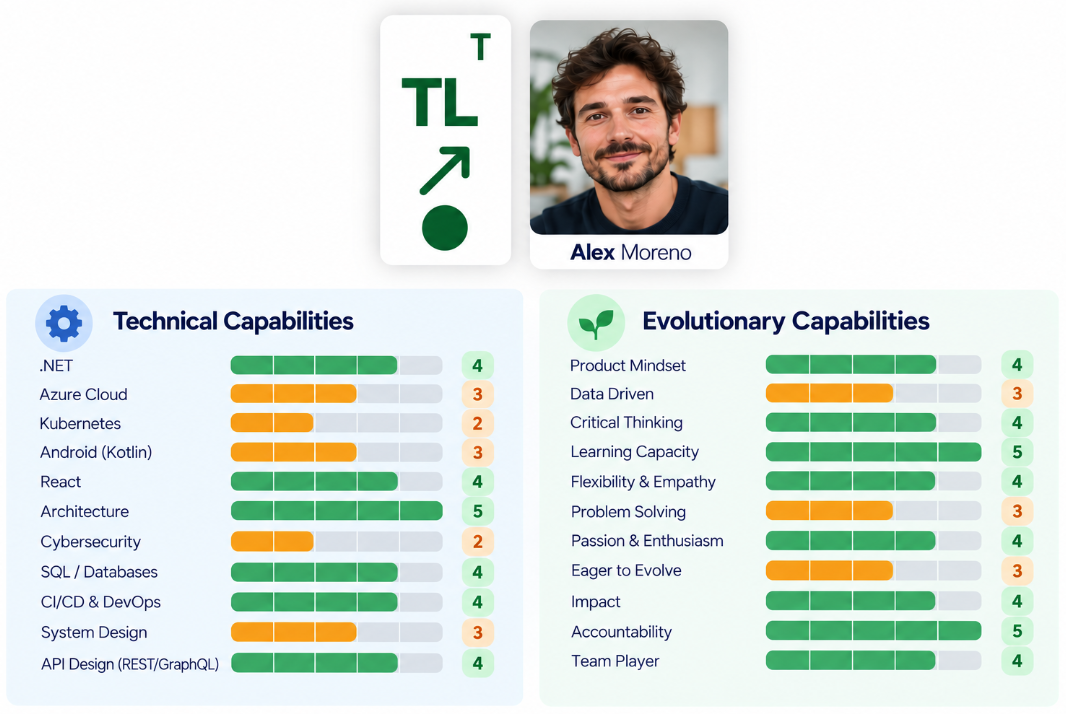
In the same questionnaire — or separately — each person performs an initial observation of system capabilities, using a scale from 1 to 5 to represent their current perception.
Two groups are observed:
Evolutionary Capabilities, proposed by SAMM as common dimensions related to a person’s ability to learn, collaborate, and evolve.
Technical Capabilities, previously defined and agreed by the team according to the product, technology, responsibilities, and context.
3. SAMM System Mapping
Once the self-observations have been collected, the System Mapping begins.
Before each conversation, the lead gathers available observations about each person, incorporating perspectives from other relevant observers within the system: Product Owners, Product Managers, other leads, or peer feedback when appropriate.
The lead contextualizes this information and adds their own observation, building the Lead Perception.
An Initial Actor Mapping 1:1 is then held:
Self-perception ↔ Lead perception
Actor Attributes and Technical & Evolutionary Capabilities are contrasted, paying particular attention to differences between perspectives.
The goal is not to determine who is right, but to understand why different observers may be perceiving something differently.
SAMM should generate conversations, not scores.
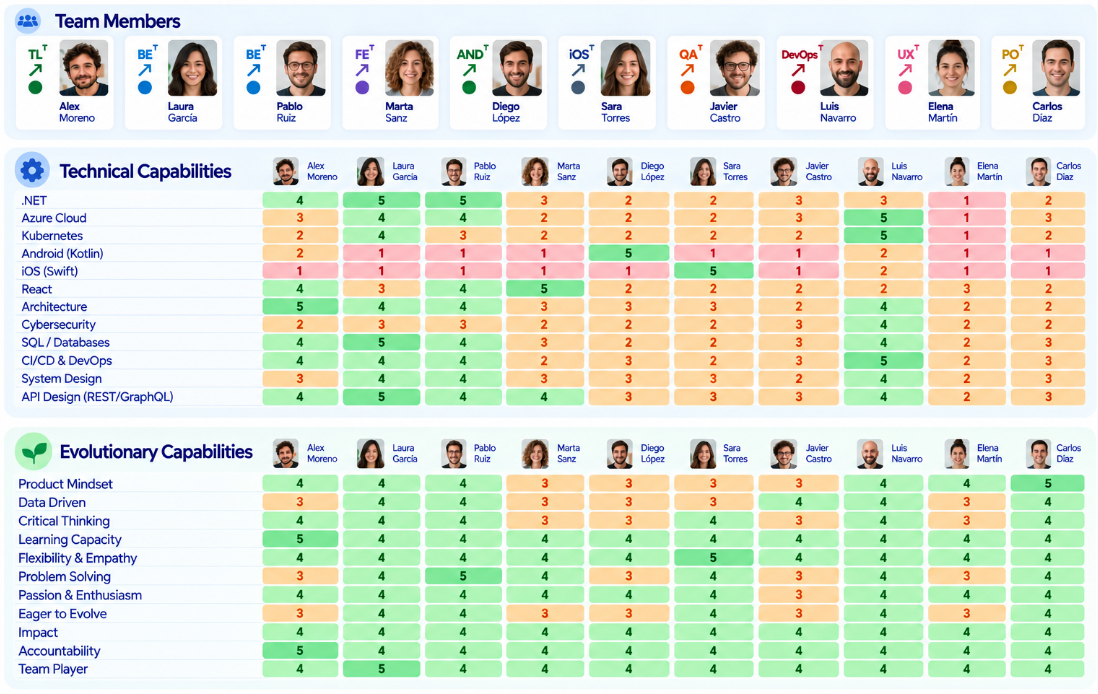
The result is the first Human Representation of the system: a starting point that will evolve together with the people and their context.
Final Teammate Representation Example
Final Team Representation Example
4. SAMM Situational Pulse
The SAMM Situational Pulse is the model’s main collective observation practice.
Its purpose is to periodically stop and understand how people perceive the system, how it is evolving, and which signals may require attention.
SAMM recommends running it every two iterations, avoiding more than one or two months between sessions.
The ideal moment is immediately after closing one iteration and starting the next: value has just been delivered, we can observe what happened, and a new cycle is about to begin. Could be the next day of planning meeting.
Recommended minimal duration: 60 minutes.
The session uses a shared interactive dashboard where each member is represented by an icon and can position themselves across the different SAMM observation areas.
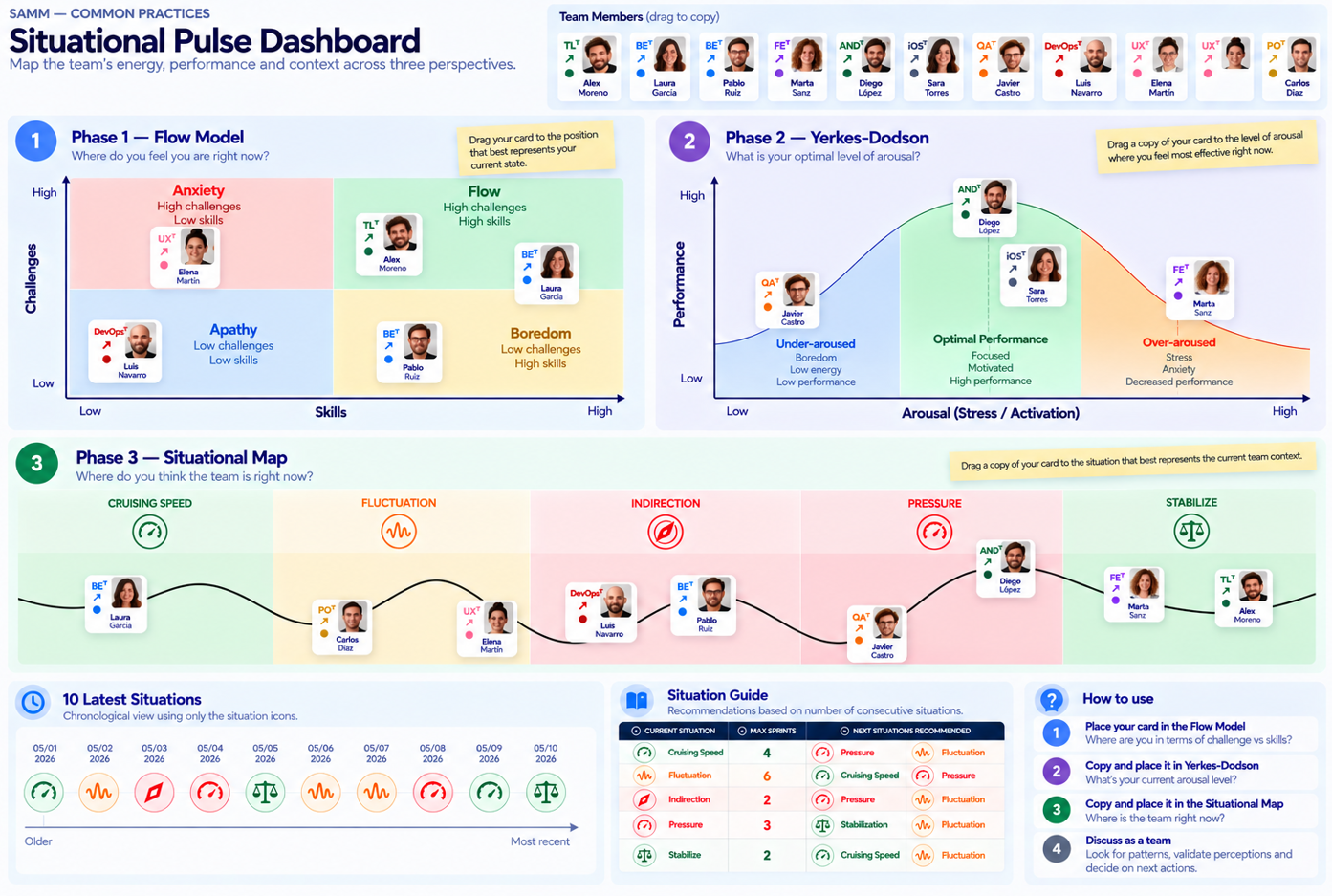
The dashboard provides a complete view of:
Challenge / Skills — Flow Theory
Arousal / Performance — Yerkes-Dodson
Current SAMM Situation
Last Iterations / Situational Timeline
SAMM Situation Recommendations
4.1. Challenge / Skills — Flow Theory
Each member positions themselves according to the challenge they are experiencing and the skills they perceive as available to face it.
Based on Flow Theory, the relationship between Challenge and Skills helps visualize states such as:
Flow · Arousal · Control · Relaxation · Boredom · Apathy · Worry · Anxiety
We are not trying to calculate a team average.
We are trying to make different perceptions visible.
If six people are in Flow and one is in Anxiety, the conclusion should not simply be “the team is in Flow.”
That difference may be one of the most relevant signals in the session.
4.2. Arousal / Performance — Yerkes-Dodson
The second observation uses the relationship between arousal and performance, taking the Yerkes-Dodson Law as a reference.
Each person indicates where they perceive themselves between:
Under-arousal → Optimal Arousal → Over-arousal
This helps initiate conversations about insufficient activation or challenge, optimal performance conditions, or excessive levels of pressure and activation.
SAMM does not use these models as psychological diagnostic tools.
It uses them as shared structures for observation and conversation.
4.3. SAMM Situation
Finally, each member indicates which SAMM Situation best represents their perception of the current professional state of the system:
Cruising Speed · Fluctuation · Indirection · Pressure · Stabilize
The situations provide a shared language for expressing and contrasting how different actors perceive the state of the system.
Significant differences between selected situations are information in themselves: different actors may be experiencing very different realities within the same system.
4.4. Observing the trajectory
SAMM does not observe only the present.
The dashboard should visually preserve approximately the last 10 iterations.
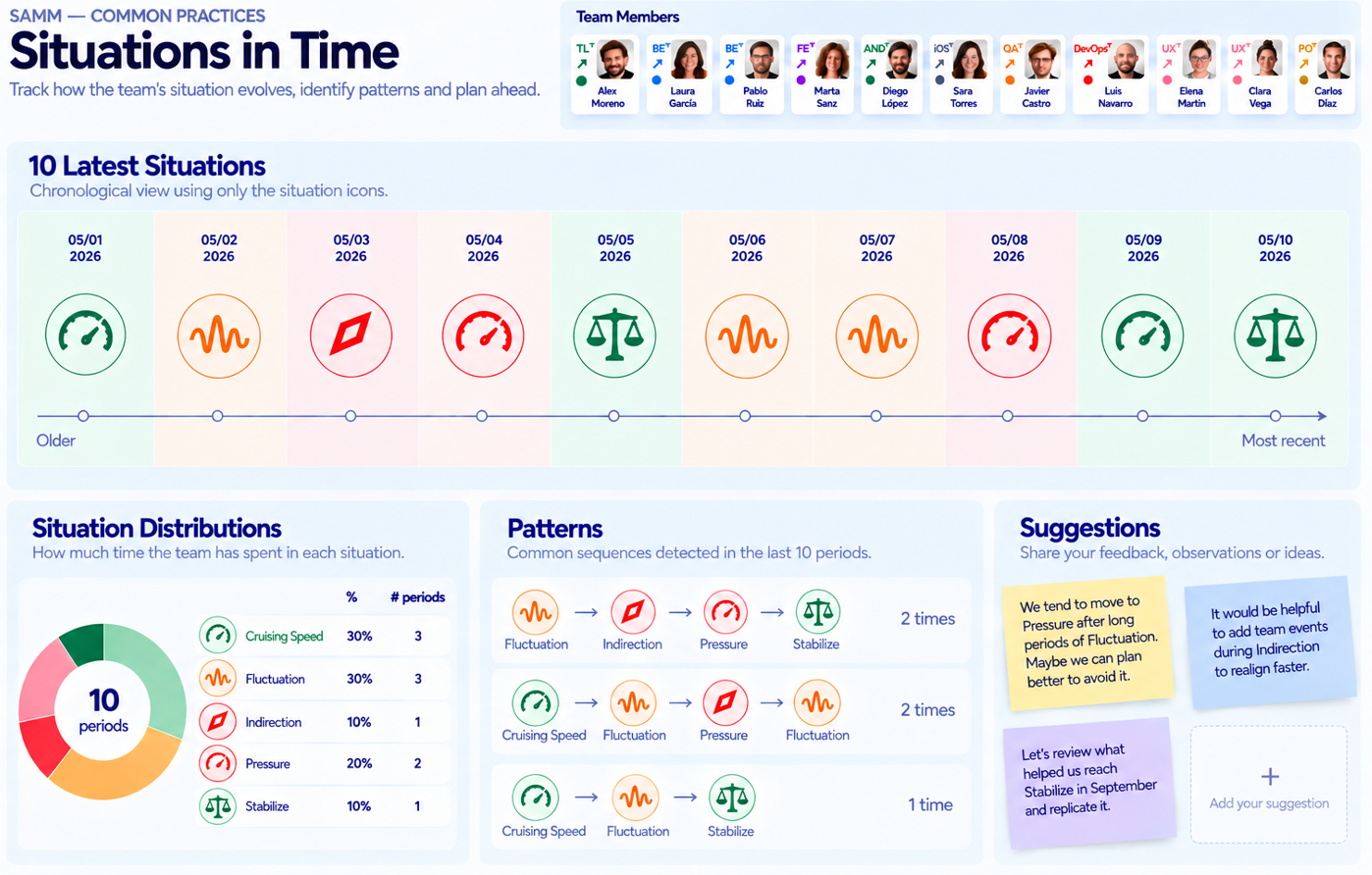
This allows us to move from observing a snapshot:
Pressure
to observing a situational memory:
Cruising Speed → Fluctuation → Fluctuation → Indirection → Pressure
The trajectory provides context and builds what SAMM calls Situational Memory.
An isolated observation tells us where we believe we are. Situational Memory helps us understand where we came from, how long we remained in certain situations, which transitions occurred, and how the system responded to previous decisions and interventions.
Instead of interpreting each new situation in isolation, we can use the accumulated experience of the system as part of future decisions.
During the Situational Pulse, we try to answer:
Where did we come from? → Where are we now? → Where do we seem to be heading?
And, most importantly:
Why?
What changed? What are we perceiving differently? Is motivation changing? Are we increasing challenge too much? Is there enough challenge? Are there individual signals that differ significantly from the rest?
The dashboard also provides SAMM recommendations regarding the expected duration of situations and possible next situations.
These recommendations are guardrails, not transition rules.
Context always comes first.
The dashboard provides signals. The conversation provides understanding.
4.5. From Observation to Intervention
The Situational Pulse does not end when a situation is identified.
Each SAMM Situation provides situational intervention roadmap, but the lead decides whether to intervene, what to do, and how to do it, considering the people, context, system trajectory, and their own leadership style.
The SAMM Situational Process, supported by mechanisms such as OODA Loop, Push/Pull, feedback loops, or Six Sigma, helps structure this process:
Observe → Understand → Decide → Intervene → Observe again
Every intervention may change the system and generate a new situation that needs to be observed again.
SAMM suggests where to look and what to consider. The lead decides when, what and how to act.
5. SAMM Tech Space
Recommended frequency: weekly.
Tech Space is the team’s recurring safe communication space.
Each member takes part in an open round where they can share how their week went and raise anything they consider relevant: technical debt, decisions, concerns, knowledge they need or want to share, technical or product areas they do not fully understand, difficulties, frustrations, or simply how they feel within the team context.
The lead should actively manage, prioritise and refine technical debt, while encouraging the team to continuously surface new concerns and add them to the shared dashboard.
It is not just a technical meeting. It is where signals can emerge that no dashboard would ever detect.
The lead participates as another member of the system, helping create an environment where asking questions, disagreeing, admitting uncertainty, requesting help, or raising concerns feels safe.
Tech Space is where the system talks.
6. SAMM Growth 1:1s
Recommended frequency: monthly. Approximate duration: 30 minutes.
Growth 1:1s are the private space where the evolution of each person can be observed over time: Actor Attributes, Technical & Evolutionary Capabilities, professional goals, growth, and possible limitations.
The initial observations from System Mapping should evolve together with the person.
SAMM Situations can also provide a shared language for individual conversations when someone considers their personal context relevant.
For example:
Professional → Cruising Speed
Personal → Pressure (Optional)
This is not about observing or intervening in someone’s private life.
The person always decides what they want to share and how far they want to go.
The purpose is to better understand their context and create space for a simple question:
How can I help you?
Growth 1:1s also include bidirectional feedback: what the person should maintain or improve, and what the lead should maintain or improve.
The lead observes the system while remaining part of the system.
7. A starting point, not a prescription
SAMM practices generate information that evolves with the system: actors, capabilities, observations, situations, interventions, and Situational Memory.
SAMM recommends preserving this information through digital support, with a clear separation between collective system information and individual private information.
In the near future, SAMM Tool will provide specific support for these practices, their history, and detailed information retrieval. Built on top of this memory, AI capabilities will progressively help detect patterns, explore possible system evolutions, and support decision-making and organizational strategy.
These practices are a starting point, not a prescription.
Every team, organization, and lead can adapt and evolve them according to their context while preserving the principles behind them.
SAMM itself should evolve in the same way: through a community of leads experimenting with the model, challenging it, and sharing what they learn across different contexts and leadership styles.
Adapt it. Challenge it. Share what you learn.