The Situational Process
In the previous articles, we explored how SAMM helps us understand a human system through the Situational Map, Situational Sensors, Situational Memory and Situational Energy. Understanding a system, however, is not enough to transform it.
Every observation eventually leads to a decision, every decision becomes an intervention, and every intervention leaves behind an experience that can be used to learn and improve.
SAMM is not intended to replace existing delivery methodologies or propose yet another way of managing projects. Instead, its purpose is to provide the versatility needed to continuously adapt them to the reality of each situation. To achieve this, it adds a layer of situational awareness that transforms situational understanding into conscious interventions, adapted to the context and driven by continuous learning.
To understand this idea, imagine a long-distance mountain trek.
Before setting off, we study the route, check the weather forecast, inspect our equipment and carefully plan the journey. Everything suggests that following the original plan should be enough to reach the destination. Yet only a few hours into the hike, reality begins to challenge every assumption. The terrain changes, a trail disappears beneath the vegetation, the wind forces us to slow down, rain arrives much earlier than expected, or one member of the group starts to show clear signs of fatigue.
None of these events changes the objective of the expedition. What changes continuously is the way we reach it. Planning remains essential because it defines the destination, but it is our ability to interpret the situation that ultimately determines the path.
Human systems behave in much the same way. Teams evolve, unexpected constraints emerge, priorities shift, new opportunities appear and people experience different levels of energy, motivation and expertise over time. In such an environment, planning remains indispensable, but it is no longer sufficient.
The real advantage lies not in following a predefined process with perfect discipline, but in developing the ability to adapt that process without ever losing sight of its purpose.
When I began shaping SAMM, I was not starting from a blank page. Over the years I had made decisions, led teams and navigated complex situations guided by an approach that felt natural, even though I could not yet explain it clearly. As I explored disciplines as diverse as military strategy, coaching and industrial engineering, I realised that many of those intuitions had already been studied by others. Rather than discovering entirely new ideas, I found a language that helped me explain why some decisions consistently produced better outcomes than others and, more importantly, how that experience could be transformed into a model that others could apply.
From that journey emerged the two drivers of continuous situational intervention within SAMM.
From Observation to Intervention
Understanding a system and acting upon it are part of the same continuous process. First, we must interpret what is happening in order to decide the most appropriate response.
Then, that decision must be translated into an intervention that fits the needs of the situation. To develop these two capabilities, SAMM draws inspiration from two models:
Deciding What to Do: Learning from OODA
The first of these models is the OODA Loop, developed by Colonel John Boyd through his studies of aerial combat in the United States Air Force. Boyd observed that success did not necessarily belong to the pilot flying the most advanced aircraft or to the one with the greatest experience. The decisive advantage belonged to those who could understand a changing situation more quickly than their opponent and adapt their decisions accordingly.
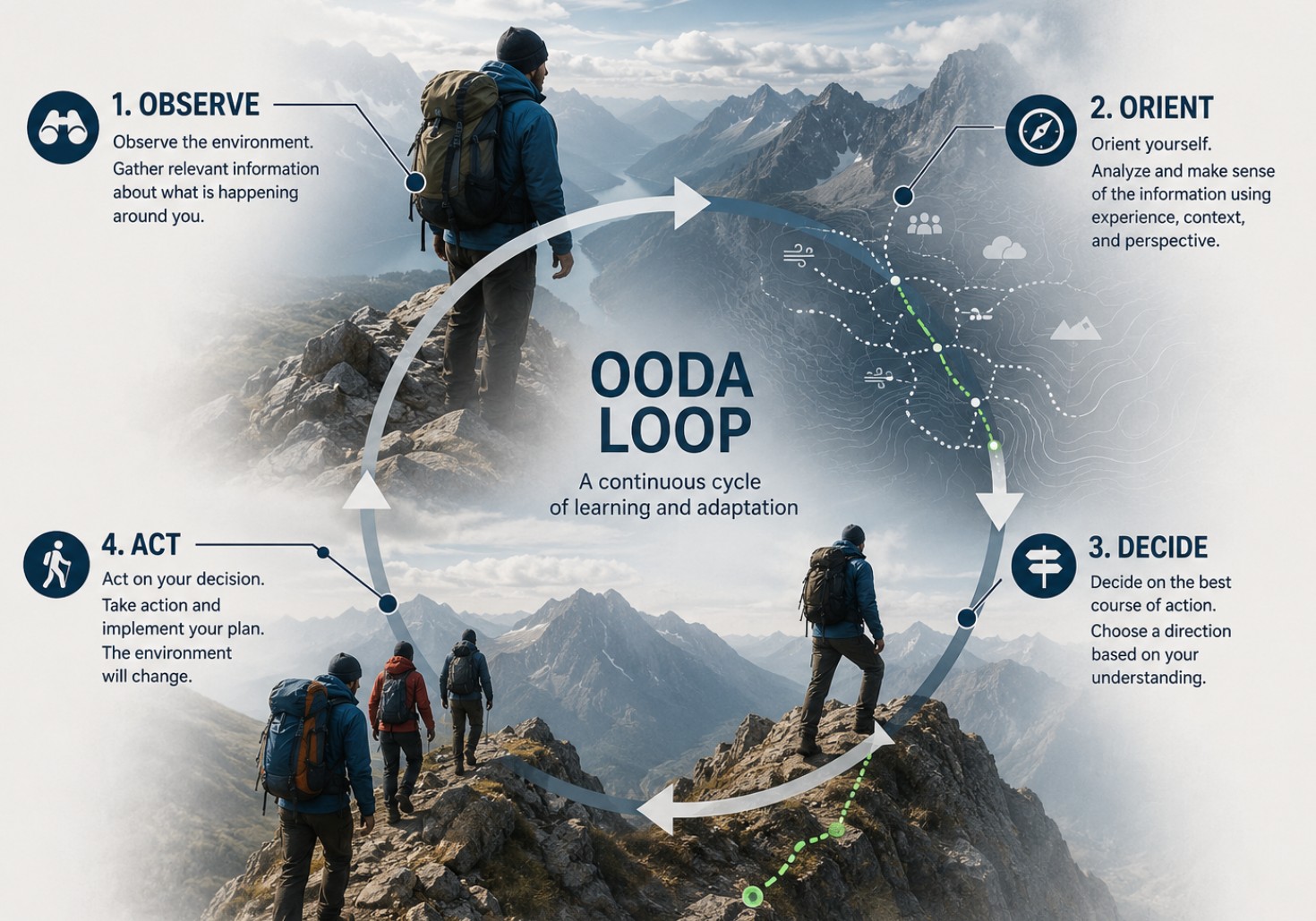
Mountain environments remind us of this constantly. Reaching the summit is rarely a matter of rigidly following the original plan; it is about continuously reinterpreting the terrain, the weather and the condition of the group without ever losing sight of the destination.
We observe what is happening, interpret that information, make a decision and act. Every action changes the system, requiring the cycle to begin again. In living systems, understanding is never a one-time activity; it is a continuous process.
Deciding How to Do It: Learning from the Push/Pull Continuum
Understanding a situation correctly does not guarantee that the intervention itself will be effective. Two leaders may reach exactly the same conclusion and still intervene in completely different ways, producing entirely different outcomes.
The Push/Pull Continuum emerged from the fields of coaching and leadership development. Authors such as Myles Downey challenged the traditional view that effective leaders should either direct or delegate. Instead, they proposed understanding leadership as a continuum between those two extremes, where the appropriate intervention depends entirely on the context. Years later, organisations such as Google adopted this philosophy through initiatives like **Project Oxygen, encouraging managers to adjust their leadership approach according to the needs of each system and situation.
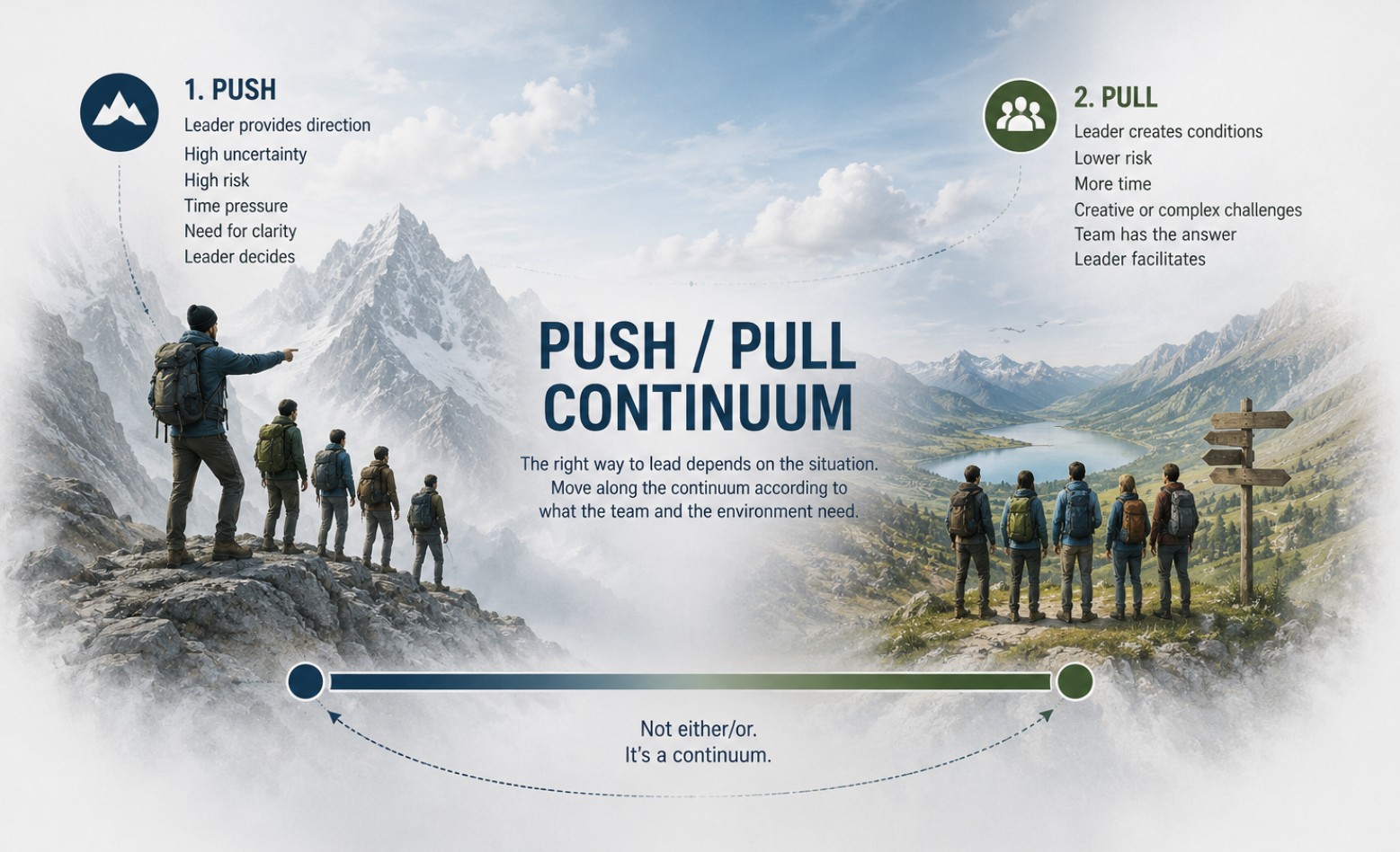
A mountain expedition offers an intuitive example. When the group must cross a narrow, exposed ridge, clear instructions and decisive leadership are likely to reduce uncertainty and improve safety. Later, when the terrain becomes straightforward again and several possible routes emerge, listening to the group’s ideas and building the decision collaboratively often becomes the better choice.
SAMM embraces this perspective because the quality of an intervention should never depend solely on the leader’s preferred style. Effective leadership comes from recognising what the system requires at any given moment. Sometimes that means providing direction and reducing uncertainty; at other times it means creating the conditions for people to discover the best solution themselves.
Learning from Experience
Every intervention changes the system and generates new information about it. That experience feeds the next observation cycle, allowing future decisions to become increasingly conscious and better adapted to the context. For this reason, the Situational Process does not end when we act; it continues as we learn from what happened.
A remarkably similar philosophy gave birth to Six Sigma. Originally developed by Bill Smith at Motorola and later popularised by General Electric, its purpose was to improve process quality through systematic observation, analysis and continuous improvement. Although Six Sigma is often associated with statistical tools, its most valuable contribution goes far beyond mathematics: every process can become a source of learning.
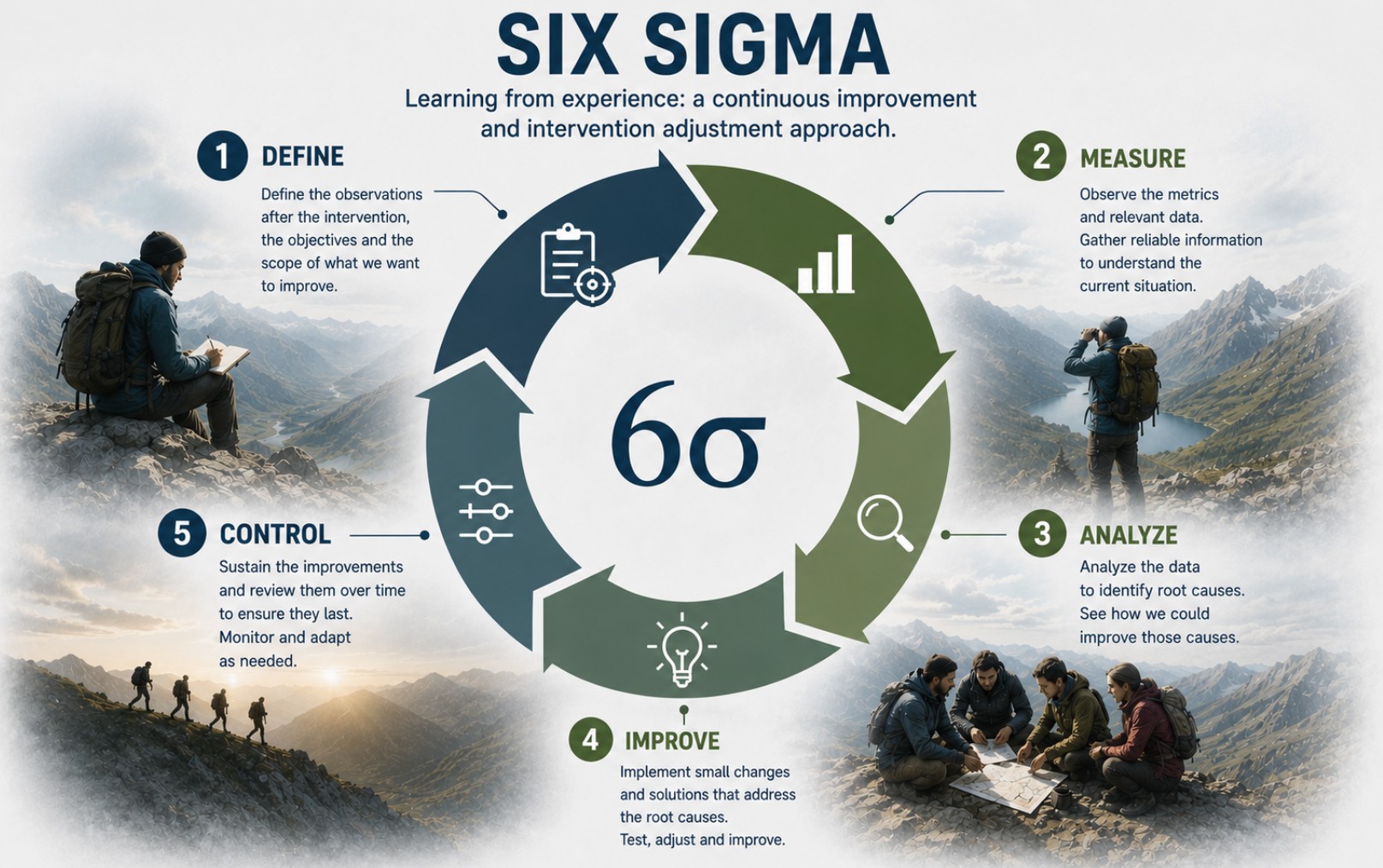
Every intervention leaves behind valuable information. Once a mountain expedition is over, it is natural to reflect on which decisions worked well, which slowed the group down, which equipment proved unnecessary and what could be improved the next time. The objective is not to judge past decisions, but to increase the group’s ability to face future expeditions more effectively.
This is the principle that SAMM adopts. Every intervention changes the system, and every outcome—whether it confirms or contradicts our expectations—deepens our understanding of the situation. Learning is no longer something reserved for the end of a project; it becomes an integral capability of the system itself.
From Static Frameworks to Adaptive Systems
Scrum, Kanban, XP, and many other approaches organize work, distribute responsibilities, help teams collaborate effectively, and accelerate the delivery of value. All of them can be extremely valuable.
SAMM does not replace or compete with any of them. Instead, it brings situational awareness to any delivery framework, improving the quality of decisions and enabling continuous adaptation to the reality of each situation.
When working with living systems, success depends less on following a predefined process than on understanding what is happening, responding consciously, and learning continuously from experience.
Rather than introducing another methodology, SAMM transforms static frameworks into adaptive systems by making situational understanding the primary driver of intervention.

A mountain expedition is never completed by following a perfect plan. It succeeds because the team understands what is happening, adapts to changing conditions, and learns from every step. Human systems are no different.
Next
In the next article, we will bring together the Situational Map and the Situational Process, creating a practical roadmap for intervention. By combining different types of situations with the adaptive process, SAMM provides guidance on when to intervene, how to intervene, and which actions are most appropriate for each situation.
Rather than prescribing fixed rules, it offers a set of situational recommendations that help shape interventions as the system evolves.
Planning defines the destination; situational awareness determines the path.