Understanding Human Systems (I): Attributes of System Actors
“A representation does not simplify reality by removing complexity. It simplifies interpretation by making complexity observable.”
In the previous articles we explored how organizations behave as complex human systems in constant evolution.
Technology changes. Processes evolve. Teams reorganize. Priorities shift. People learn.
Every one of those changes transforms the situation in which the system operates.
If situations continuously evolve, an obvious engineering question emerges.
How can we represent a person within a situation without reducing a complex human system to a collection of metrics or personal characteristics?
This is the challenge SAMM attempts to solve.
Rather than introducing another management theory, SAMM integrates existing knowledge into a common representation that simplifies the interpretation of complex human systems.
It does not replace psychology. It does not replace Agile. It does not replace organizational design.
Instead, it provides a situational observation framework capable of transforming multiple disciplines into a shared language that supports better understanding and better decisions.
Like every engineering model, simplification does not mean ignoring complexity.
It means building a representation that preserves what matters while reducing unnecessary cognitive effort.
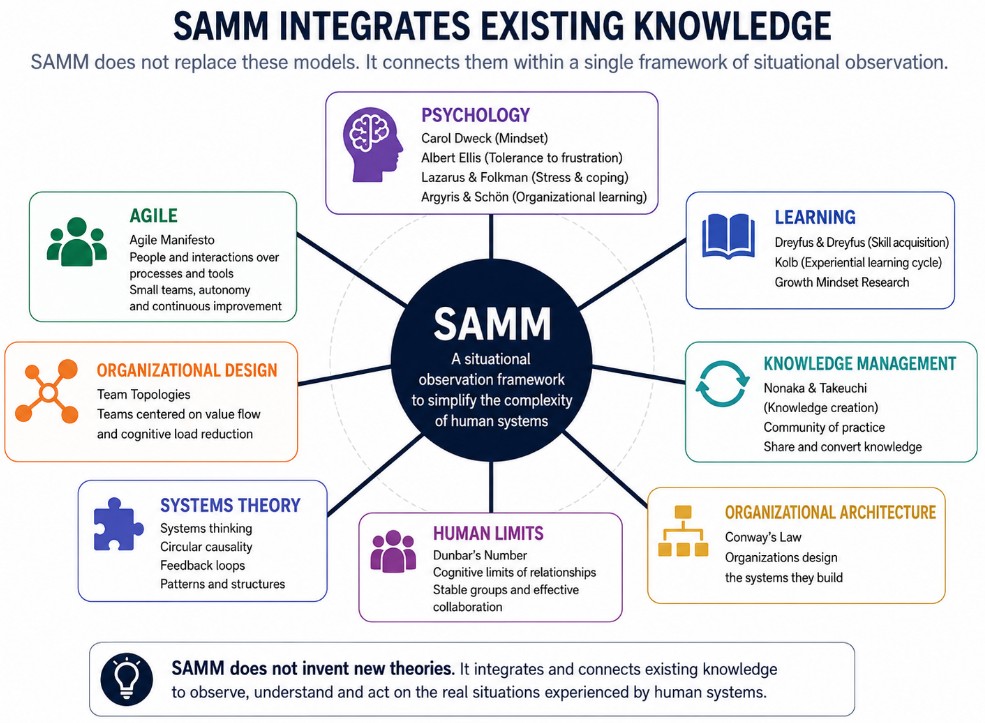
The purpose of SAMM is therefore not to reinvent existing knowledge, but to integrate it.
Disciplines such as knowledge management, psychology, learning theory, organizational design, and systems thinking already provide valuable perspectives for understanding people and the systems in which they operate.
SAMM brings these perspectives together into a single observational framework, providing a consistent and practical way to represent and understand complex human situations.
Representing People Within Situations
Every engineering discipline relies on representations. Architects use blueprints, software engineers use architectural models, control systems rely on sensors, and electrical engineers interpret signals. These representations are never the real system; they are simplified views that make complex systems easier to observe and interpret.
SAMM follows the same philosophy. However, its representation is neither a representation of the person nor of the situation alone.
A SAMM representation describes a person within a specific situation.
That distinction is fundamental. The representation does not try to answer:
Who is this person?
Instead, it helps us understand:
How is this person interacting with this situation right now?
The same individual may therefore have completely different representations depending on the project, team, responsibility, organizational context, or simply the moment in which the observation takes place. The objective is not to describe people, but to understand situations through the people who experience them.
Every SAMM representation is therefore contextual, temporal, and dynamic. It represents a person at a specific moment, within a specific situation, with the purpose of interpreting how that situation is evolving.
This changes the role of the representation completely. It is not a profile, an assessment, or a classification, but a shared representation that makes a complex human situation observable.
Human Indicators as Situational Sensors
Once the objective is to represent a situation through the people experiencing it, another question naturally follows:
How is that representation built?
Engineering rarely attempts to understand a complex system through a single observation. Instead, it relies on multiple sensors measuring different dimensions such as temperature, pressure, voltage, or speed. Each signal provides only a partial view, but when interpreted together they create a much richer representation of what is happening within the system.
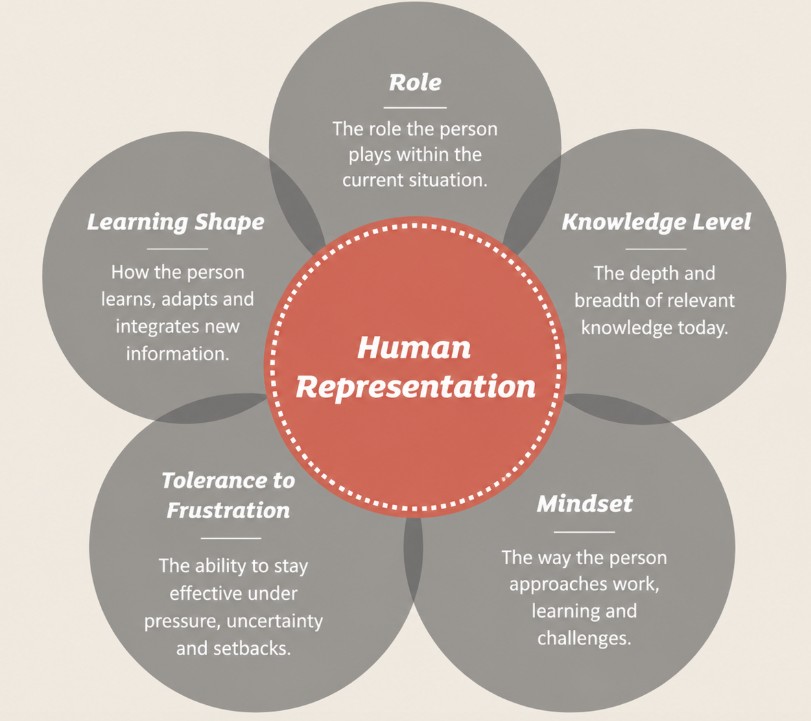
SAMM applies the same principle to human systems. Its Human Indicators are not personality traits, classifications, or assessments. They are situational sensors.
Each indicator captures an observable dimension that contributes to the representation of a person within a specific situation. No single indicator is intended to explain the person or the situation on its own; their value emerges when they are interpreted together and within context.
Rather than inventing new concepts, SAMM integrates perspectives developed across psychology, organizational learning, systems thinking, and organizational design into a common representation that helps make complex human situations observable and easier to interpret.
Knowledge Level
Knowledge strongly influences how people interpret situations, recognize patterns and make decisions.
This indicator draws primarily from the Dreyfus Model of Skill Acquisition, the work of Nonaka & Takeuchi on organizational knowledge creation, and Argyris & Schön on organizational learning.
Within SAMM, Knowledge Level does not describe how much a person knows.
It represents the knowledge that is relevant for understanding and responding to the current situation.
Mindset
Two people with similar knowledge can react very differently to exactly the same situation.
Often the difference lies in their willingness to learn, adapt and experiment.
This indicator is inspired by Carol Dweck’s work on Growth Mindset and Fixed Mindset.
Within SAMM, Mindset is not considered a permanent characteristic.
It represents how the current situation influences a person’s openness to learning and change.
Learning Shape
Modern organizations require both specialization and collaboration across disciplines.
The concept of T-Shaped Professionals, introduced by IDEO and popularized by Tim Brown, represents this balance between deep expertise and broad collaboration.
SAMM uses this indicator to observe how a person expands knowledge beyond a primary specialization and contributes across domains when the situation requires it.
Frustration Tolerance
Every complex system generates uncertainty, pressure, unexpected change, and a continuous need for adaptation. Understanding how people respond to these conditions, and how they affect their ability to continue contributing effectively, is essential for interpreting how a situation may evolve.
This indicator draws on research into resilience and emotional regulation, particularly the work of Albert Ellis and Richard Lazarus & Susan Folkman.
Within SAMM, Frustration Tolerance is not intended to measure emotions or define an individual’s personality. Instead, it represents how the conditions of the current situation may affect a person’s ability to continue contributing effectively within the system.
Current Role
Every observation requires context, as the same situation can be experienced very differently depending on a person’s responsibilities and technical skills within the system. SAMM therefore incorporates the current organizational role as contextual information.
Within SAMM, the role is not intended to describe or define the individual. Instead, it provides context about the position from which a person experiences and interacts with a particular situation.
None of these indicators is particularly meaningful in isolation. Knowledge without context tells us very little, just as mindset without considering responsibilities provides an incomplete picture. Similarly, understanding someone’s role without considering their learning capacity offers limited insight into how a situation may evolve.
Only when interpreted together do these indicators provide the contextual representation that SAMM uses to support situational understanding.
A Common Representation
SAMM provides a way to bring these individual observations together into a common representation, making it easier to share perspectives, identify differences in perception, and develop a collective understanding of what is happening within the system.
The objective is not to classify or evaluate individuals, but to communicate how a specific situation is experienced and reflected through the people involved.
Each representation is simply a snapshot of a person within a particular situation at a particular moment. It provides a shared starting point for understanding the present, while recognizing that both people and situations continuously evolve.
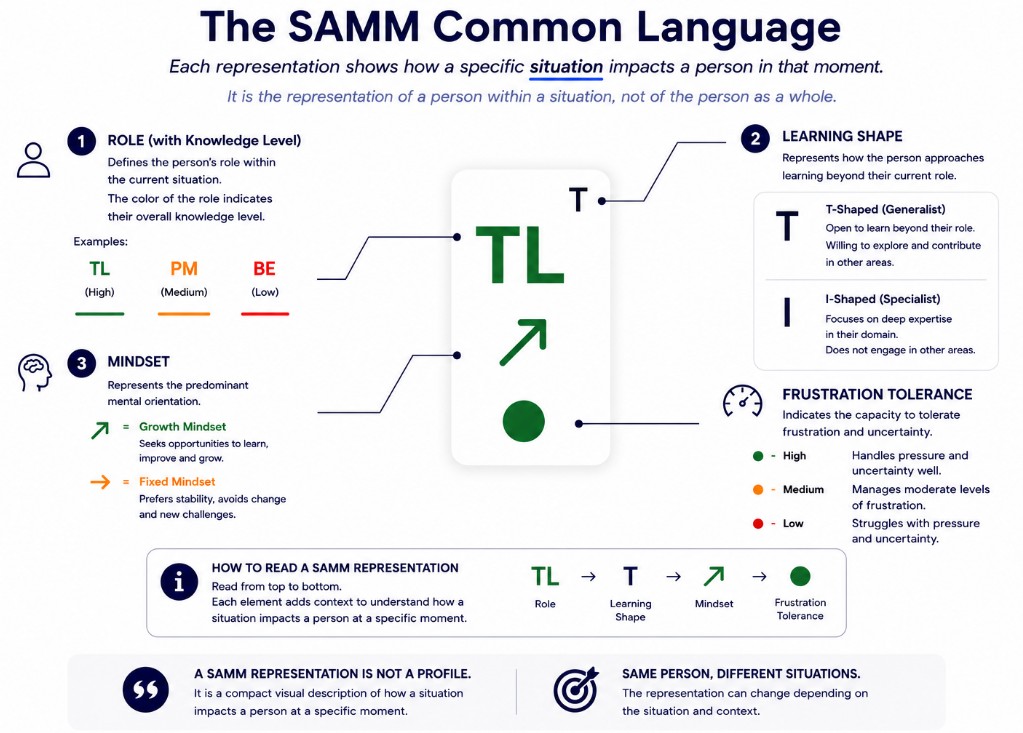
The notation is intentionally minimal. Each visual element represents a situational indicator and, when interpreted together, they provide a compact representation that can be understood consistently across teams.
The notation itself is not the model; it is simply a shared language for making observations visible and easier to communicate. Its value does not come from the symbols themselves, but from the interpretation and conversations they enable.
Observing at Human Scale
Representation also has practical limits. As organizations grow, complexity increases much faster than our ability to understand it, which is one of the reasons many modern organizational approaches encourage small, autonomous teams.
Frameworks and concepts such as Amazon’s Two-Pizza Teams, or Dunbar’s Number approach this challenge from different perspectives, but they share an important principle: keeping human systems at a scale where relationships and interactions remain observable.
SAMM follows the same philosophy. Smaller teams do not eliminate complexity, because complexity is > an inherent property of human systems. They simply help keep that complexity within human observational limits.
This principle also explains how SAMM scales. Rather than attempting to observe an increasing number of people simultaneously, SAMM changes the scale of observation: from the individual to the team, from the team to the department, and eventually to the organization.
The fundamental object of observation remains the human system; what changes is the scale from which we observe it.
Learning from Representation
A representation is never the final objective. It is a starting point for learning and for understanding how the system evolves over time.
Situations generate observations, and those observations create representations from which we can form hypotheses and make better-informed decisions. Those decisions may change the system, creating new situations that need to be observed and interpreted again.
Over time, this continuous cycle allows patterns to emerge. These are not personality patterns, but situational patterns that can help us understand how the human system tends to respond under different conditions.
SAMM therefore does not attempt to explain who people are. It seeks to understand how situations evolve through the people experiencing them, using that understanding to continuously improve decision-making.
The Contribution of SAMM
SAMM is not intended to be another personality framework, leadership model, or organizational methodology. Its contribution is to provide a common way of representing people within specific situations, integrating established knowledge from multiple disciplines into a shared language for situational interpretation.
Understanding a complex human system is not simply about collecting more information. It is about building a useful representation that allows different observers to make their perspectives visible, discuss the same situation through a common language, and make better-informed decisions together.
In SAMM, that representation never describes the person in isolation.
It always represents a person within a situation.